
Souks, Sahara sands, sunsets and steaming hot weather….
Marrakech had been on my bucket list for a long while, so I was really excited when we finally landed in ‘The Red City’ (so named due to the coloured pigments from the soil within the walls and buildings).
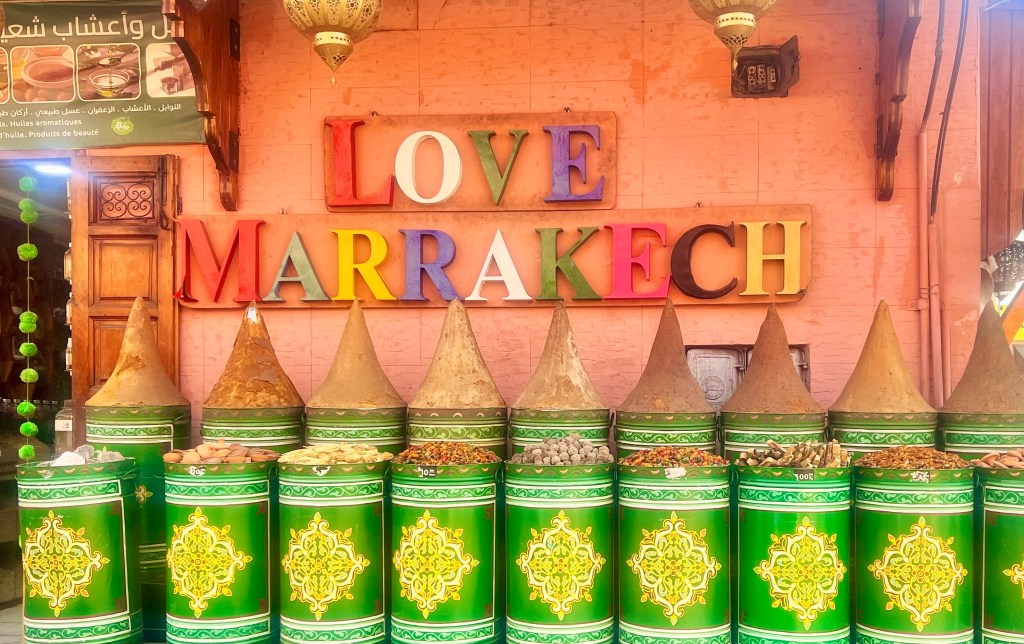
Without question, there’s so much you will want to cram into your visit to Marrakech, but here’s my Top 10 must-see/ must-do’s to ensure that you can get the most out of your Moroccan adventure….
If you have a TikTok account, you’ll also find my videos are linked throughout.
1. First and foremost, stay in a Riad!
Let’s face it, there’s little point in going all the way to somewhere as culturally exotic as Marrakech and staying in a sterile, soulless, corporate hotel! If you want a true, authentic Moroccan experience, my advice is to stay in a Riad in the Old Medina instead! You’ll be so glad you did.
Riad’s are typically old mansions built around a small garden or courtyard, converted into hotels offering a small number of generously sized rooms. We enjoyed four nights in the lovely ‘Riad 58 Blu’, which turned out to be a little oasis of calm, just five minutes from the hustle and bustle of the busy souks!
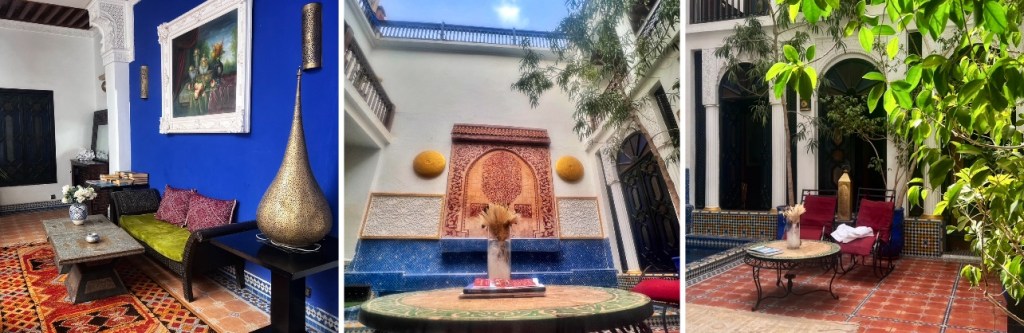
Our room – or rather, suite, because it was so spacious – was full of charm, character and colourful textiles! This came with a large bedroom, a living space and a huge bathroom. Our bedroom window even opened out onto the centrepiece courtyard, complete with small bathing pool and rocking loungers. It was perfect!
For just a small additional sum, we chose to go half board at the Riad and were treated to plentiful breakfasts of freshly baked bread and fresh fruit, and delicious and varied meals each evening – a favourite being slow-cooked meat and vegetables in a tagine.
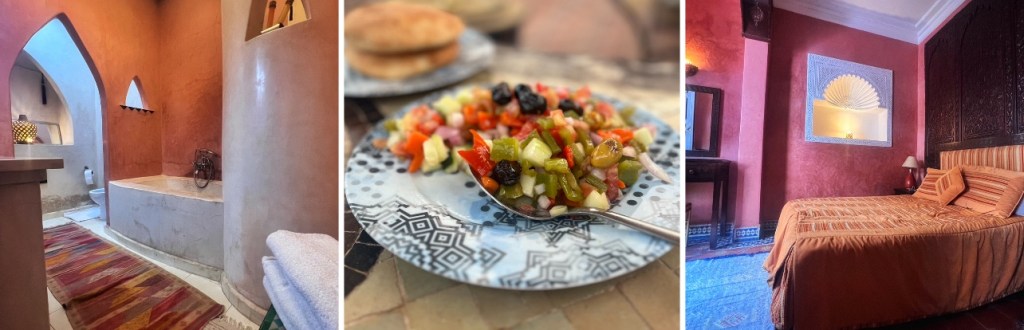
We learned that it is tradition to eat your dinner alongside the other guests and usually later into the evening (around 8.30pm – 9.00pm). This meant sharing a table – and plates of food – with our fellow travellers. Rather than this be an awkward experience (us Brits aren’t always the most sociable), it was actually quite an enjoyable way to meet new people and swap tourist tips!
🎥 Take a look inside Riad 58 Blu!
2. Souks in the city!
The ancient city walls of the Old Medina consist of a labyrinth of super-narrow streets and alleyways, bursting with market traders, tourists, donkeys and mopeds.
The souks are something of a maze and navigating them successfully is a skill that only a few master. Getting lost is expected.
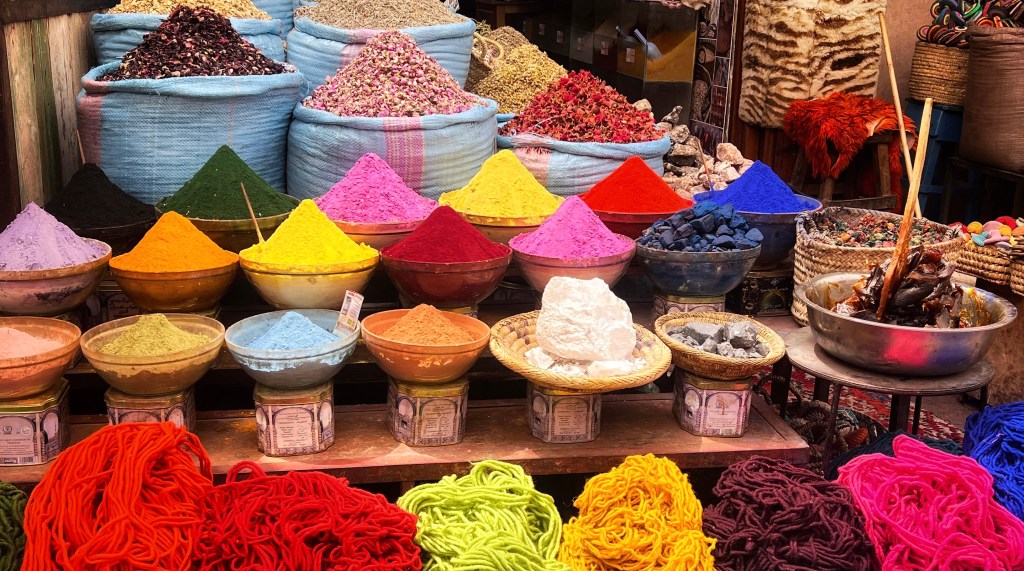
Way back, Marrakech’s first inhabitants made their living trading luxurious goods with buyers entering the city by sea. Today, the trading continues at pace, albeit less ‘luxurious’ now than in the days of old. The hundreds of stalls are crammed full of all kinds of everything from aromatic spices, to ornate lanterns, to hand-dyed rugs, teapots, ceramics, carpets, argan oil, fes hats and ‘babouches’ (Moroccan slippers). If you want it, chances are, the souks will have it – and at a very good price.
If you like haggling (like me), you’ll love the experience of shopping the souks. Arguing the price of something is completely expected and the best bargains can be had if you’re a little bit cheeky and can hold your nerve. Of course, this type of exchange isn’t for everyone; if bargaining really bugs you (as it did my partner), then you won’t enjoy this aspect of Moroccan culture.
When visiting the souks, be prepared to be pestered by every single trader desperate for your custom. The easiest way to avoid this becoming too much of a nuisance, in my option, is to ignore and walk on – impolite as that may feel!
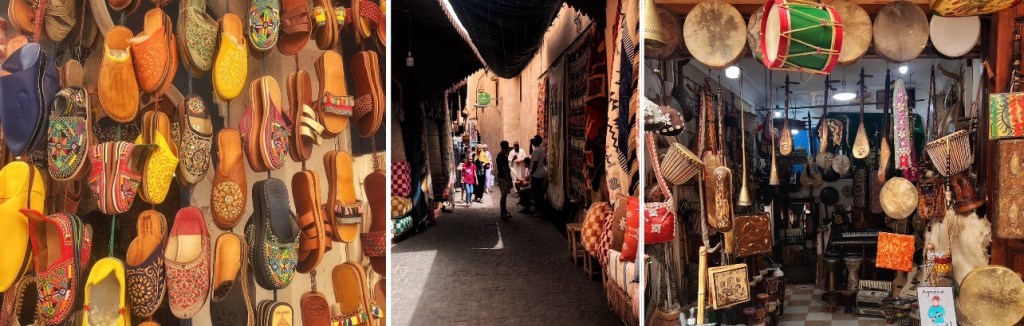
Souks don’t come with handy maps – where would be the fun in that? Instead, try and pick out your own little ‘landmarks’ along the way or explore late afternoon when the stalls begin to close down.
Tip: You can opt to hire your very own tour guide who will be sure to show you the sights and delights of the souks – but don’t trust the first person who approaches you on the streets. Unfortunately, there are many scammers keen to fleece you for cash, or deliberately guide you outside of the medina and straight to their family businesses. If you stay at a Riad, they will always provide a recommended service, which is much safer.
3. Take time out in Le Jardin Secret
Slap bang in the middle of the busy medina – and yet feeling a world away – lies Le Jardin Secret, which translates as ‘Secret Garden’. And what a hidden secret this is – when eventually you find it tucked away in a side alley deep within the souks.
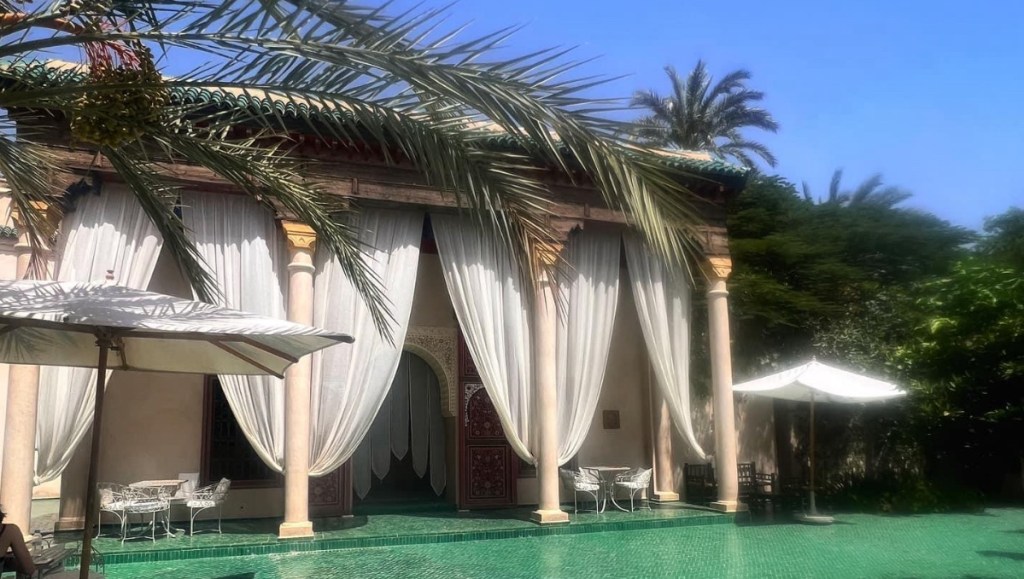
Le Jardin Secret dates back to the second half of the sixteenth century and is spectacularly gorgeous – I mean, my photos say it all. The gardens boast exotic plants from all over the world, a tranquil Islamic garden under the shade of palm trees and a glistening pool of water providing a calming area to sit, reflect and cool off from the blazing sun.

Whether beautiful gardens are of interest to you or not, Le Jardin Secret provides the perfect welcome break from the busy medina. Trust me, after a few days in a city that hustles as Marrakech hustles, you’ll need the respite! The on-site rooftop cafe is also a lovely spot to sit and savour a spot of lunch, whilst taking in the oddly contrasting views of red city and green gardens.
🎥 Watch my Secret Garden video.
4. Take in the famous Jemaa el Fna
It’s fair to say that the Jemaa el Fna is the most well renowned tourist destination in the whole of Marrakech and up there with the whole of Morocco – and therefore, it’s a must-see experience for anyone visiting.
This large, open square in the heart of the city actually translates as ‘assembly of the dead’ – a reference to a time when the heads of executed criminals would be displayed here on spikes.
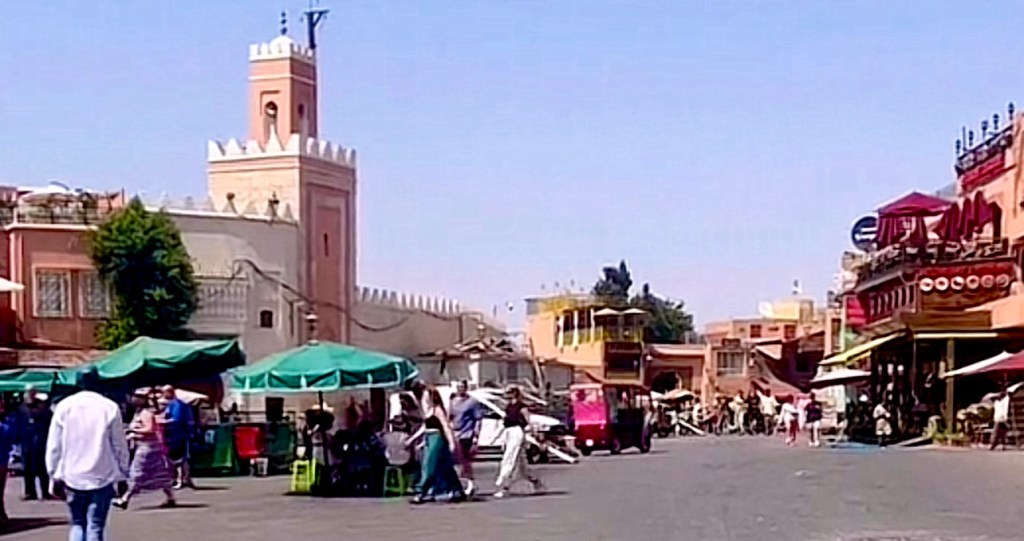
Nowadays, the square is full of activity and entertainment with a number of cafes, restaurants, fruit stalls and hotels. It also brings in huge crowds with various street acts from dancers to musicians, storytellers, fortune tellers, tooth-pullers and herbalists – many of which come out after sunset when the square really comes to life.
Tip: For the best spot to watch the action in the square, head up to one of the rooftop cafes such as Cafe Argana.
Sadly, any visitor to the Jemaa el Fna will also see unpleasant acts of animal cruelty and this is where differences in Moroccan culture really become apparent in the most horrible way. The ancient ‘art’ of snake charming sees cobras and vipers appear to dance to the hypnotic sound of drums, tempting tourists to pay for a photo with a snake draped over their neck. Being bitten won’t happen as the snakes have their mouths sewn shut and soon die of starvation, before simply being disposed and replaced for another.
Don’t be fooled by the ‘Monkey Men’ either. They dress their Barbary Macaques in silly clothes in yet another attempt to entice tourists to have their photo taken with a monkey on their shoulder. Look closer and you’ll see that the monkeys are tied tightly to chains – in pain and ridiculed in the name of entertainment. The ‘Monkey Men’ are also often part of criminal gangs who poach the baby monkeys from their lives in the wild.
Definitely do go to see the Jemaa El Fna for the cultural experience – but please choose not to entertain the acts of animal cruelty or take your own photos.
5. Hear the call to prayer at Koutoubia Mosque
The huge twelfth century Koutoubia Mosque is the central place of worship in Marrakech. It has stood tall in the centre of the city since the 12th Century and is visible – and walkable – from the Jemaa el Fna square.
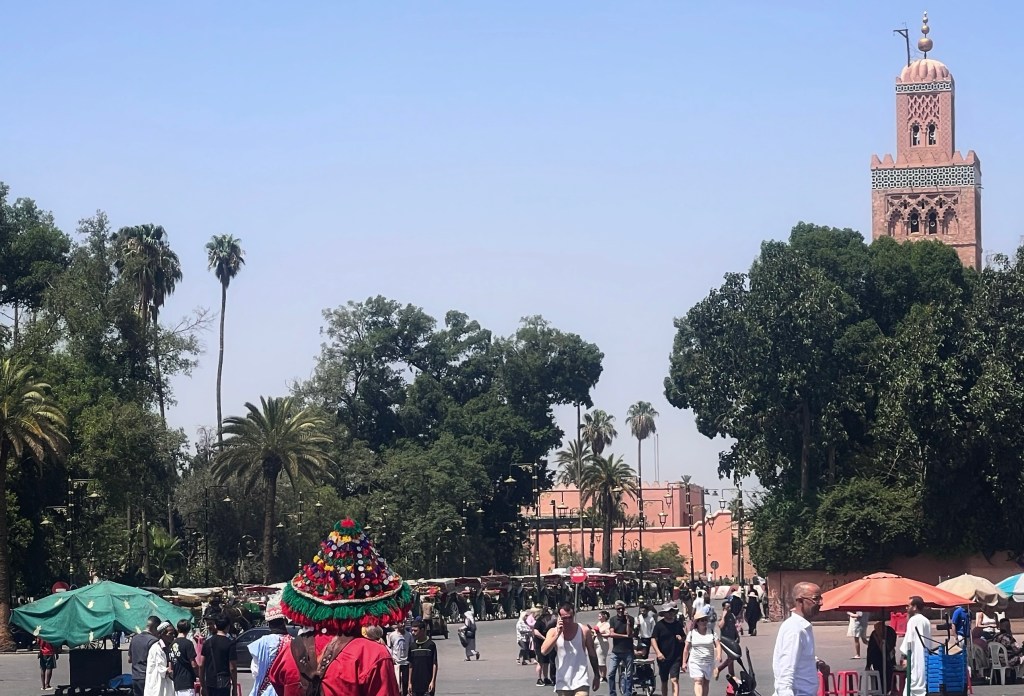
Unfortunately, but understandably, entrance into the mosque is denied to non-Muslims – but that shouldn’t stop anyone going to have a look at this impressive and iconic building.
Like all mosques, Koutoubia faces towards Mecca (the birthplace of Islam) in the direction in which all Muslims must pray. However, unlike all mosques, Koutoubia comes with its own interesting facts. The first is that a wide, spiral ramp has been built inside to accommodate a horse being ridden to the top (whether tried and tested, I don’t know)! The second is that the mosque provided the original inspiration for the Cathedral in Seville (Spain is just an hour away by ferry). Thirdly, the local law prohibits any new buildings from standing taller than Koutoubia Mosque, such is its prominence.
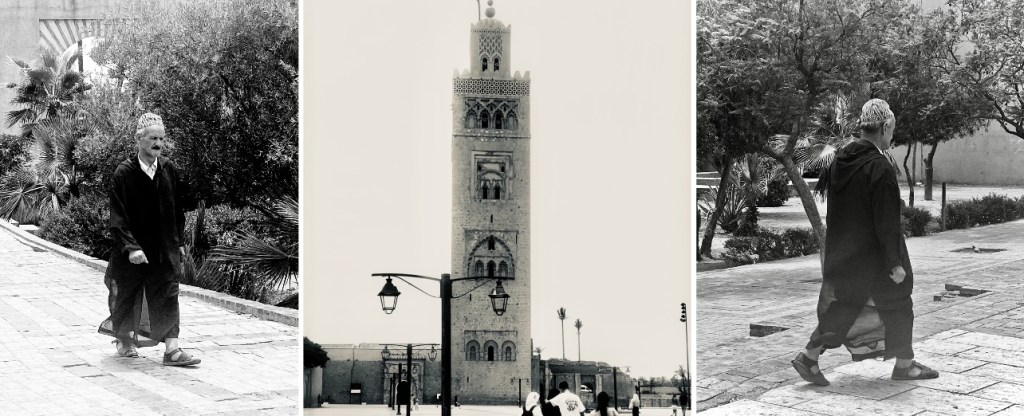
There are five daily calls to prayer, each one piping out of the high minaret – and if you happen to witness one up close, as we did, it’s quite an impressive sound!
6. Get your chic on at Majorelle Garden!
Marrakech is definitely a city of two halves, a place where dusty streets live alongside polished paving. Just outside of the old walled medina lies a French-inspired district that is more chic than chaotic. More classy than cluttered.
The luxury district of Gueliz is where you’ll find the super-swanky Majorelle Garden and Yves Saint Laurent Museum – yours to explore for 300 dirhams (or around £22, per person).
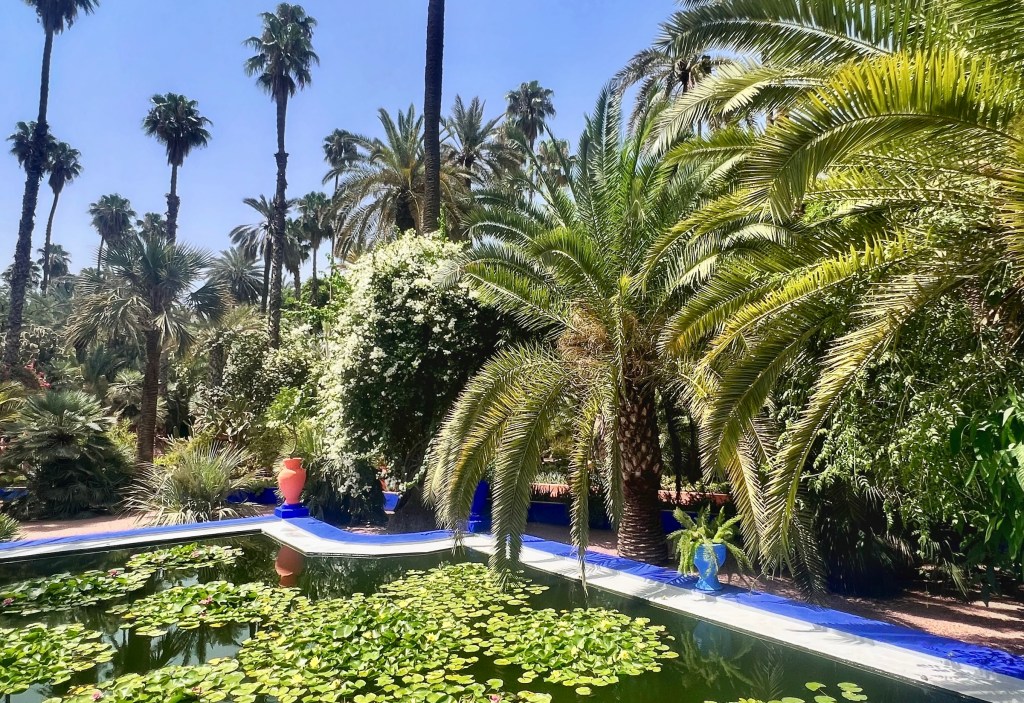
Majorelle Garden spans twelve acres of pure, blissful botanical gardens. Leafy palm trees, vast lily ponds and an art-deco pavilion make themselves at home here, alongside fish, frogs and butterflies.
This posh plant-filled playground was created back in the 1920s by the French painter, Jacques Majorelle who clearly had an eye for beautiful things in beautiful surroundings. Amidst the greenery is one colour that dominates the garden – a deep shade of electric blue (now trademarked under the name ‘Majorelle Blue’). Majorelle is said to have drawn his inspiration from the colour of Moroccan tiles in kasbahs and the traditional Berber clothing when designing his colour palette.
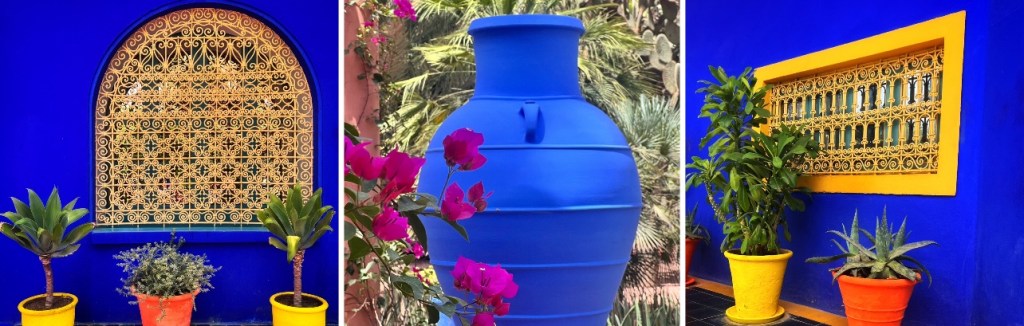
Upon Majorelle’s death in the 1960s, the garden was purchased by the famous French fashion designer Yves Saint Laurent. Who better to take over something so magnificent as a world-renowned fashion icon with his own creative eye? YSL then owned it until his own death in 2008.
In memory of Yves Saint Laurent, the gardens house a museum displaying fifty of his most iconic and colourful pieces. If you fancy taking a piece of YSL home with you – and why wouldn’t you? – there’s a nice gift shop selling his replicas and other souvenirs to take home and make your mates jealous with!

Tip: Tickets for Majorelle Gardens must be purchased online and you’ll be asked to specify an entry time. Don’t underestimate the walk there from the old medina – the maps of Marrakech are never as simple as they look. If time is right, do as we did and jump in a taxi (they are surprisingly cheap if you remember to agree the price upfront).
🎥 Watch my video to take a virtual tour
7. Marvel at the stunning La Bahia Palace
Marrakech has more than its fair share of fancy palaces, but only a handful that you’ll actually be able to visit.
We took a trip to La Bahia Palace which was located in the centre of Marrakech within the old Jewish Quarter, and surprisingly easy to find (phew).
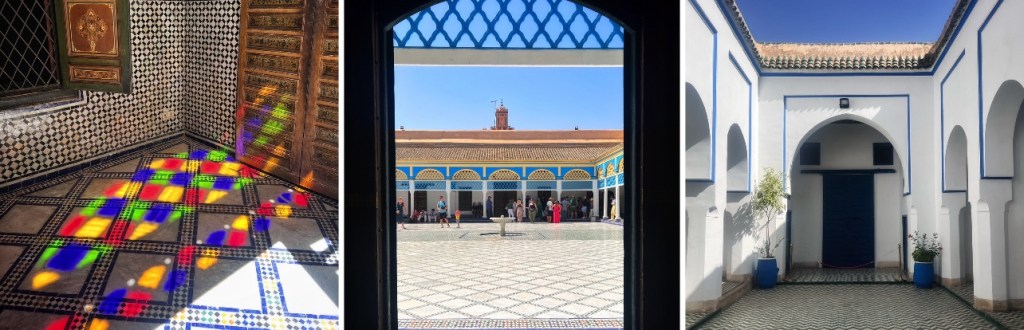
This nineteenth century mansion exudes luxury and elegance from floor to ceiling and it’s clear than no expense was spared! It spans 8000 square metres and the word ‘Bahia’ means ‘brilliance’ or ‘beautiful’. The palace was the creation of a rich Sultan who named it after the term he used for one of his wives!
Visitors are free to roam and explore the entire palace, which comprises a huge open courtyard, a built-in mosque, a relaxing hammam (traditional thermal spa), marble bathrooms and pretty gardens stretching 8,000 square metres. All this for a mere 70 dirham entry fee, which worked out around £6 per person.
🎥 Take a look at La Bahia Palace.
8. See the ruins of El Badi Palace
El Badi Palace (also centrally located) provides quite the contrast to the perfectly polished Bahia Palace as it now stands almost entirely in ruins. Despite this, it remains a must-see as one of Morocco’s oldest – and largest – palaces, built in the sixteenth century by a super-wealthy Sultan with considerable style!
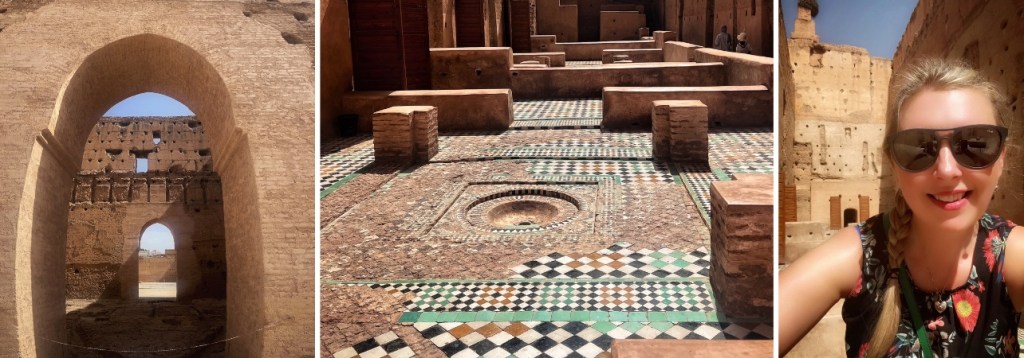
When built in the 16th century, this magnificent palace was said to be the most impressive palace in the western reaches of the Muslim world! It had more than 350 rooms, some paved with gold, turquoise and crystal – earning the Sultan the name ‘The Golden King’. As well as a huge living space, it had courtyards, fountains, four sunken gardens and a massive 90 metre swimming pool/ reflections pool – which can still be seen today (clearly empty)!
At the beginning of the 18th century another rich Sultan purchased the palace – but for the sole purpose of stripping it of its rich materials which he then transported off to Meknes, a city in northern Morocco, in order to furnish a new palace. If you’re keen to know more, pay a visit to the exhibition in the subterranean chamber where you can find out about the palace history, including the conditions of slaves and prisoners who once resided in the underground chambers.
Everything that remains today shows just a glimpse of what the once luxurious palace would have looked like. It’s also a UNESCO World Heritage Site and favoured lodging of nesting storks which can be seen high above! Like La Bahia Palace, the cost to experience this is minimal – and very much worth it.
🎥 Take a look at El Badi Palace.
9. Take a trip to the seaside!
As a city that lives off tourism, Marrakech offers a huge range of day trips and excursions that will provide opportunity to see more of what Morocco offers. And the best thing? They are unbelievably affordable!
We were enticed by an organised day trip to the seaside town of Essaouira, leaving behind the chaos for the coast. This was super-cheap at around £20 per person and took approximately 2.5 hours each way by mini-bus – air-conditioned, thankfully!
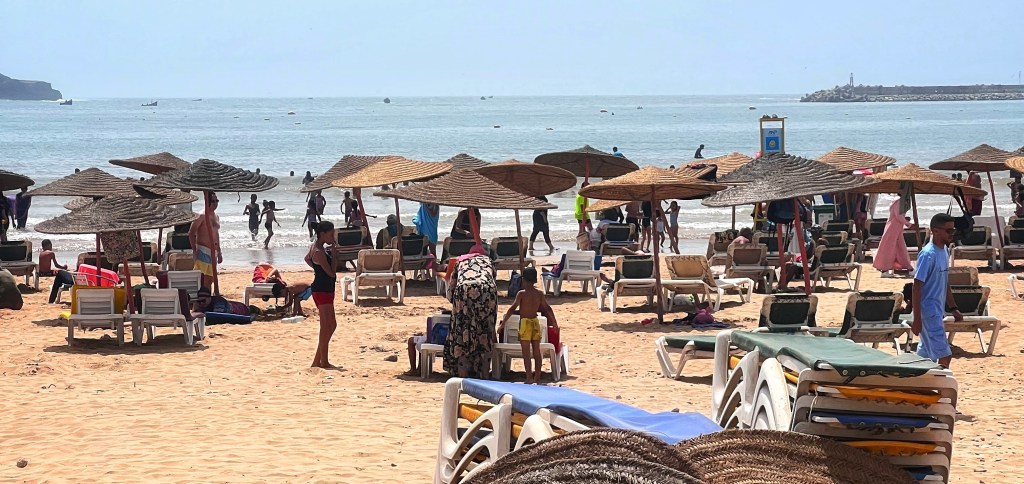
Essaouira is a port city on Morocco’s Atlantic coast. In the 1960s, it was a haven for hippies and backpackers arriving into Morocco from Spain. Today, it is a popular hotspot for wealthy Moroccans and tourists alike, each enticed by the pretty 18th century harbour and long stretch of sandy beach, popular with windsurfers and kitesurfers.
Be mindful that if you usually head to the beach sporting an itsy-bitsy-teeny-weeny-yellow-polka-dot-bikini (or the male equivalent), do remember that Morocco has a very strong Muslim culture and so dressing modestly and respectfully should really be the rule of thumb. Even in 40 degree heat, yes.
The old town medina, by contrast, feels free and easy with a modern feel. There’s plenty of attractive restaurants and cafes adorning the streets, as you’d expect to find in any holiday hotspot. We happened to stumble across a fantastic seafood restaurant called Il Mare, where I enjoyed a fish soup and ocean views.
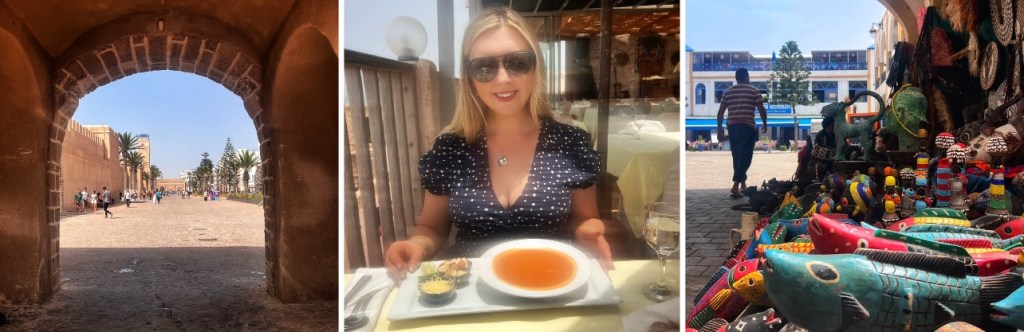
The most noticeable – and refreshing – difference was the souks in Essaouira compared to those of Marrakech. They were quieter and far more leisurely to walk around, without the continual effort of traders to lure you in and the need for eyes in the back of your head to dodge mopeds! Here, you felt able to peruse pleasantly, which was undoubtedly a more enjoyable experience for my partner! We even bought a rather fetching tagine and some art!
The excursion gave us a relatively generous 4 hours to explore the delights of Essaouira and in terms of great value, it was right up there!
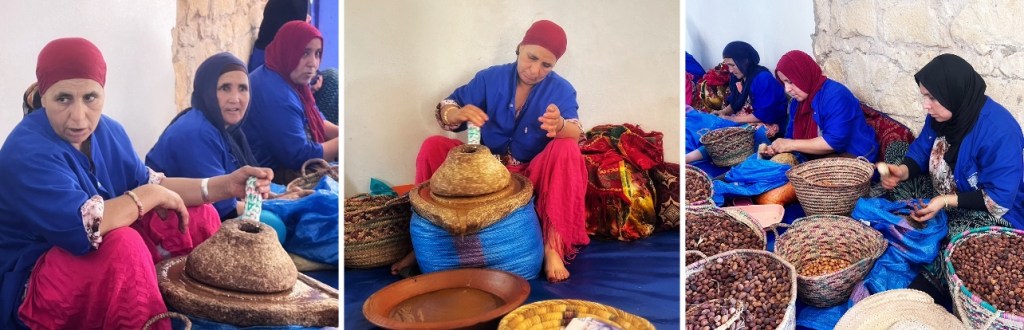
Tip: As is likely the case with any organised trip in Morocco, expect to make a number of obligatory stops along the way – in our case, a small cafe and an Argan Oil cooperative – the idea being to bring custom to businesses (often family, friends or those offering the organisers incentives). As it turned out, the visit to the Argan Oil cooperative meant that we experienced seeing a group of Berber women cracking Argan nuts to extract the sought after oil. Judging by Western standards this might be considered exploitative, but it’s a fact that life looks different in Morocco. Regardless, we made sure to give the ladies some money.
10. Taste the culture with a mint tea!
If there’s one thing I’m going to leave you with that is an absolute must-do in Marrakech, it’s to sample the traditional mint tea! It might not sound all that and more, but believe me – it is.
If I haven’t mentioned already, finding alcohol in Marrakesh is the only thing more difficult than navigating the souks! As such, the traditional holiday beer was quickly replaced by the traditional mint tea – and it didn’t disappoint! The Moroccans are right when they say it is the most refreshing drink in 40° heat!

Each restaurant or cafe will make the tea a little different than the last, depending on style and preference, however the key ingredients are peppermint, spearmint, green tea and sugar, all boiled up in hot water. If you want my opinion, add in as much sugar as your diet permits for extra tastiness!
Because Mint Tea is so important to the Moroccans and they take great pride in the presentation, the tea is served in a metal teapot, straight into small glasses rather than cups. It is also poured from a great height, which is actually quite a skill. This ensures the tea has a foam on it. No foam, no good!
Tip: Why not copy me and buy your own teapot and glasses from the souks, to make your own mint tea back home?
So there you have it – my tips for your trip to Marrakech! Although we fit a lot into our 4-night visit, we didn’t manage to tick everything off the ‘tourist list’ – including quad biking in the desert, taking a hot air balloon ride at sunrise or trekking the Atlas Mountains. A return trip may be on the cards (if I can convince my other half)…
Comments below 👇🏻

 Sun, See and Suitcase
Really enjoyed reading this – great to see the videos. Not sure I’d cope with the heat!
LikeLike