
Zakynthos – also known by its Italian name, Zante – is the Greek island escape that offers sun, sea and….spectacular coves!
As well as being blessed with the bluest ocean, Zakynthos is one of the greenest islands in Greece, full of cypress trees, olive groves and colourful wild flowers. In fact, it’s sometimes referred to as ‘The Flower of the East’ due to the east wind that is said to carry the perfume of the wild flowers out to the Ionian sea.
I managed to see the majority of the island, thanks to hiring a car – and if you want to make the most of your time in Zakynthos, I’d highly recommend you do the same!
Alykes
We stayed in Alykes (Panos Apartments) – one of a handful of beach resorts in the north east of the island.
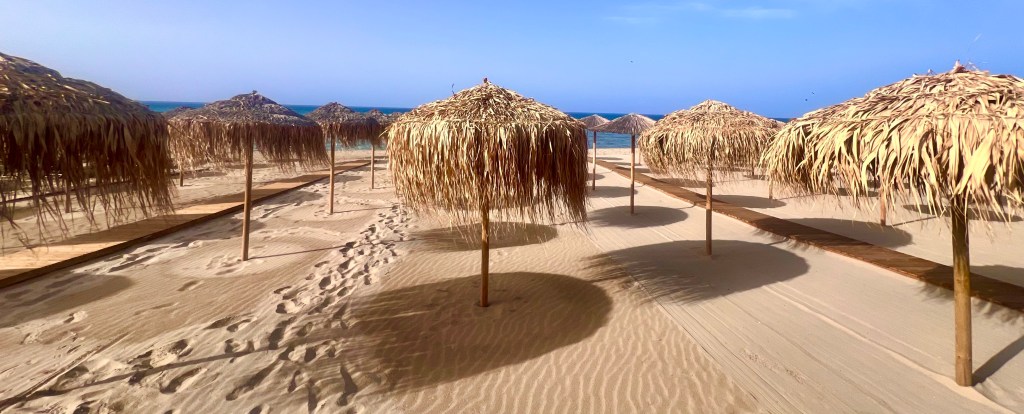
Although relatively modest in size, Alykes has all you need for a great holiday, including cosy cafes, beach bars, tempting tavernas, a few small supermarkets and little boutique shops.
The ‘Blue Flag’ sandy beach in Alykes was lovely and quiet during our visit in May, with a scattering of sun-beds for hire and opportunity to indulge in various water sports, had we have chosen. Like most of the resorts we found in Zakynthos, you can also hop aboard a boat trip from Alykes, which will take you out to the famous Shipwreck Beach or Blue Caves (but more about them later).
Something that is completely unique to Alykes and which you won’t find in any other resort, is the old ‘saltworks’ that can be found behind the beach and main village.
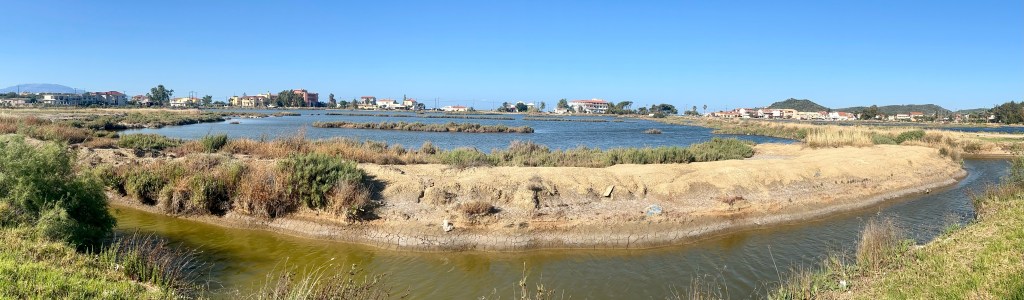
The saltworks were originally a vast area of shallow lakes set up so that the Zakynthians could produce salt through evaporated seawater. Nowadays, its role as a salt-producer is redundant after it became apparent that it was considerably cheaper to import salt than to produce it locally. Instead, it now serves as a haven for birds and other wildlife.
Alykes practically blends with another small village called Alykanas, separated only by a stone bridge over a little fishing port. The walk between the two is short, taking approximately 15 minutes and almost entirely along the stretch of beach. Alykanas has a little harbour and like Alykes, offers water sports, holiday apartments, eateries and enough places to enjoy a well-earned Mythos beer in the afternoon sun!

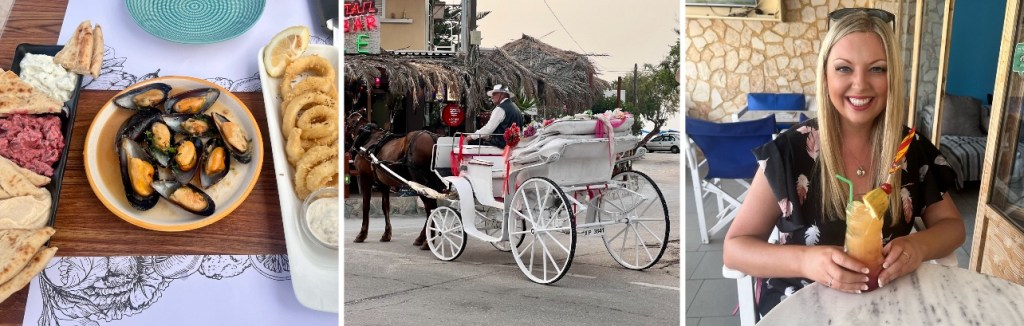
Whilst on the important subject of eating and drinking, we tried most restaurants and bars over the course of the fortnight – all in the name of research for this blog, naturally. If you want posh seafood with sea views, ‘Fishalido’ is just the ticket. ‘Nostos’ is best for mouthwatering homemade moussaka, ‘Pitta Break’ for cheap but super-tasty gyros and ‘Relax’ for something a little different, such as the salmon kleftiko that I devoured! But my absolute favourite was ‘Porto Paradiso’ for the relaxing beach bar atmosphere, cute beach-shack-style decor and extensive food and drinks menu. If you then find that you’ve had one too many cocktails – and why not, you’re on holiday – the local taxi service in Alykes consists of horse-drawn carriages!
Interesting fact: Don’t be surprised to find swallows nests in many of the bars and restaurants – complete with the bobbing heads of hatchlings! Apparently, it is considered to be lucky for a nest to be built on a premises, hence the owners not removing them.
The Blue Caves
On every Zakynthos bucket list has to be the famous Blue Caves! We drove through coast and mountains to the most northerly point – Cape Skinari – and from here took a ‘glass bottom’ boat trip out to the Blue Caves, which are only reachable by water.

I’d carefully chosen a boat trip with ‘Potamitis Bros’ despite many on offer across the island, simply as it offered the shortest excursion, at just 40 minutes. I’m not a keen swimmer so get bored on the 3-hour long boat trips that build in several lengthy ‘swim stops’. It’s just not for me.
Our friendly captain took us into many of the magnificent caves, all of which dazzled with gorgeous deep electric blue and turquoise coloured water. Being glass bottomed, you could also see the fish swimming under the boat.
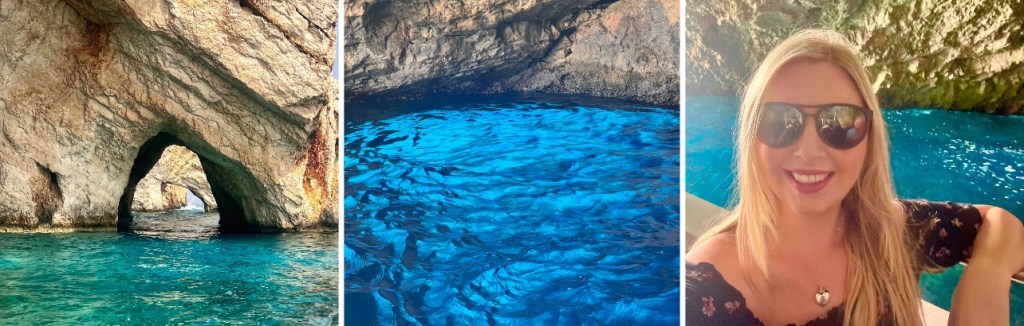
The name ‘Blue Caves’ originates from the vibrant reflections from the water inside them, which happens when the sea rises and the sulphur from the caves radiates. Although I’ve not been to Capri, apparently the Blue Caves of Zakynthos are likened to the famous Blue Grotto. It’s pretty obvious to see why the Blue Caves are one of the island’s most famous treasures, attracting thousands of visitors each year – it’s not every day you get to see inside caves where the water is so naturally iridescent!
Our captain also pointed out the ‘Bat Cave’, which had an opening that resembled the Caped Crusader himself….
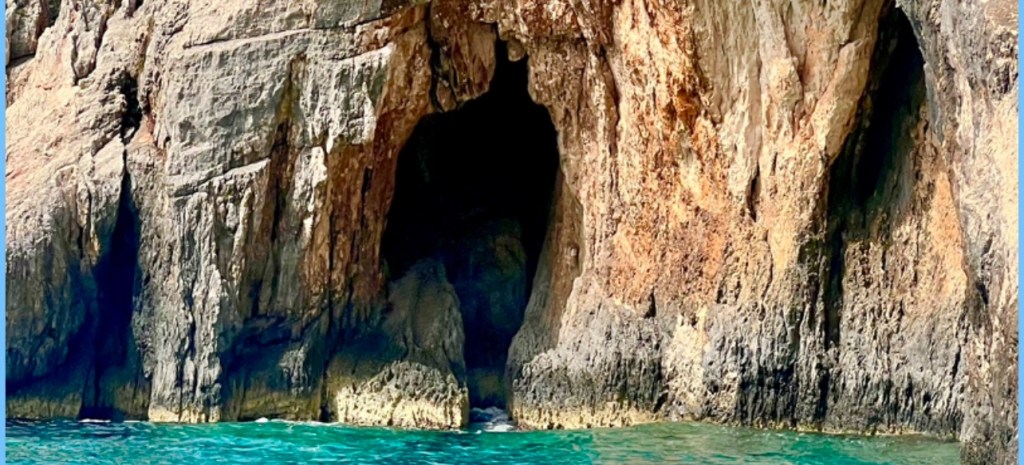
At just €15 per person, this boat trip was great value. Boats depart every 15 minutes from the bottom of the lighthouse and there’s no need to book ahead, at least not in May. If you do want the entire swim-experience, Potomitis Bros offer longer excursions to Shipwreck Beach too, which factors that into the itinerary.
When you’re done with the caves, just 2 kilometres up the road is the Potamitis Windmills – and these aren’t to be missed either! Who says windmills only belong in Amsterdam?
The two windmills are, in fact, luxury accommodation but serve as the perfect backdrop for your insta too! The on-site ‘Windmill Restaurant’ is also the perfect spot for breathtaking panoramic views of the caves, coves and crystal sea below. We chose to sit outside, behind a clear glass panel, and enjoyed an alfresco salmon salad whilst taking it all in! Honestly, I found no restaurant views that could rival it on the whole of the island!

It’s also from here that you can walk down the 100 stone steps to the sea for a spot of sunbathing. You’ll find a handful of loungers on a raised deck, but be there early with your beach towel if you want to secure one!
Cape Keri
On the opposite side of Zakynthos, on the south west coast, sits the mountain village of Cape Keri and its famous lighthouse landmark. I’d heard that the view from the top of the 328 foot cliff was not to be missed and that Cape Keri was home to the ‘Guinness World Record Biggest Greek Flag’, so we took the hour long drive to see it for ourselves.

When you enter the village of Keri, the roads become extremely narrow and a little chaotic (bare knuckle might be more apt) and so we parked up and walked the 1200 metres down to the lighthouse, past poppy fields, olives groves and a horned goat, thinking this would be the smartest move.
Imagine the disappointment when we found that not only was the flag not flying, but the lighthouse was shut too! After quite a climb in 24° heat, I can safely say that we were more bemused (and sweating) than the masses of quad bike riders making u-turns!
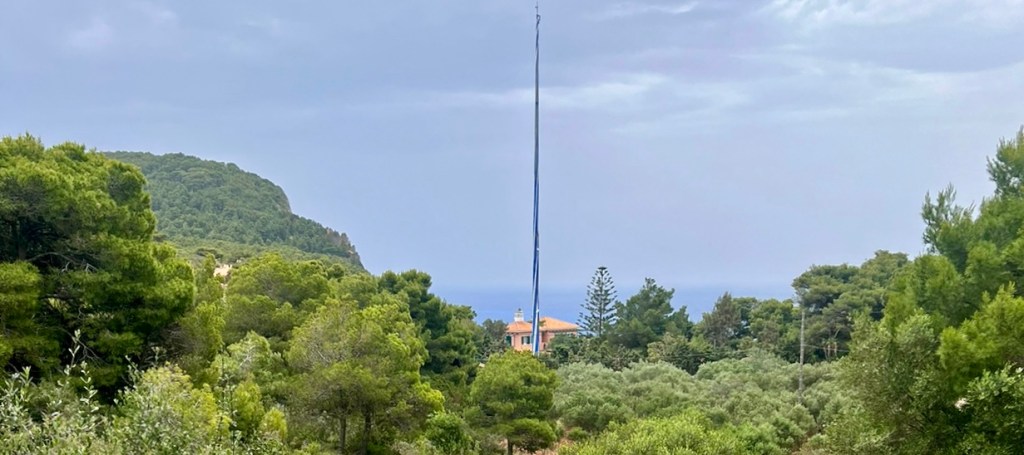
That said, just a short distance from the ‘sorry-not-today-lighthouse’ we noticed groups of people walking up a steep rubble path leading through a forest. Hoping against hope that there would be something worthwhile at the end, after approximately 15 minutes we found the most stunning views of turquoise coves and rugged cliffs. Phew – Plan B worked!

A 2 kilometre drive from Cape Keri will take you to the small beach village of Limni Keri. There’s around five or six restaurants, a supermarket and not a lot else – which, incidentally, is the charm of this place – quiet, serene and almost entirely to yourself if you time it right.
After our earlier walk, it proved to be the perfect spot for us to enjoy a beachfront lunch.
Laganas
Just a 13 kilometre drive up the coast from Keri – and yet a world away – is the infamous Laganas. From the subtle and sublime to the seedy and sleazy….
We decided to pay Laganas a quick visit and find out why it is responsible for having given Zakynthos the reputation as the ‘Greek party island’. Despite timing our visit during the day (and when most partygoers were probably in a booze-fuelled slumber), yes indeed, it was clear to see that Laganas is not the most beautiful part of the island.
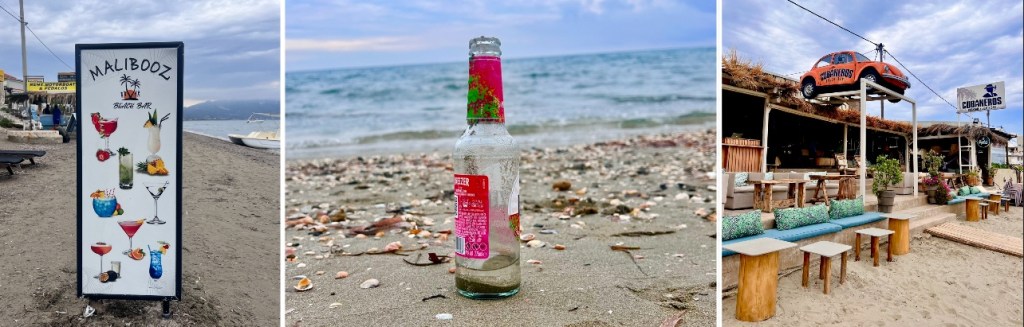
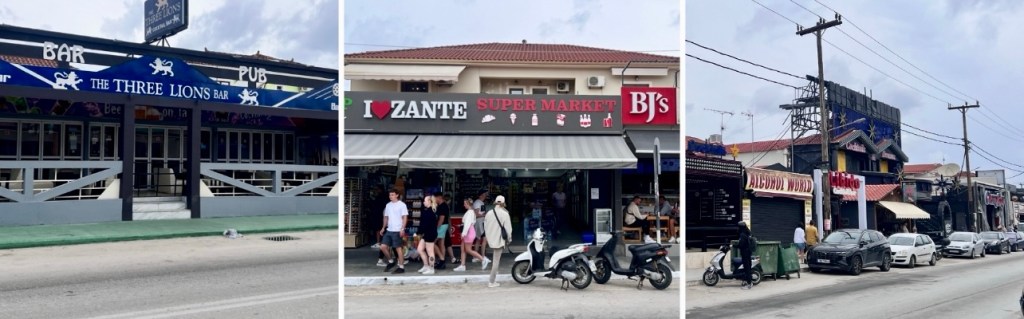
Glass bottles from the night before littered the sand. Footy-themed ‘Brit bars’ replaced traditional tavernas. Illuminated strip club signs dominated the billboards. Cheap and nasty discount stores sold all of the party ‘essentials’. McDonald’s was thoughtfully thrown in for the hangover too. Now I do love a McDonalds, but it’s not exactly the culture I’m looking for in Greece….personally speaking.
After a fleeting visit, my verdict was in; Laganas is a bit like Blackpool-in-the-sun, minus the ‘kiss me quick hats’ – and no doubt with its own take on the ‘Pleasure Beach’. That said, I can appreciate that it has its purpose as a fun package holiday for 18-30, stag and hen do’s and anyone who has far more stamina than I do.
Interesting fact! Laganas is a breeding ground both for the endangered loggerhead turtles (known as ‘Caretta’), as well as humans. Back in the early 1980s when there was the tourism boom in Zakynthos, the turtles were forced out of their natural habitat to make way for holidaymakers and high rise hotels. Naturally, this caused a massive uproar with the environmentalists and today there is a protected marine area along the Laganas coastline to allow the breeding to continue. This means that the beaches are closed from dusk to dawn and flights in and out of the nearby airport are also restricted to daylight hours only. In fact, one of the reasons we were drawn to Zakynthos ahead of other Greek islands was because the flight times were good. Turtle power!
Navagio (meaning ‘shipwreck’) Beach
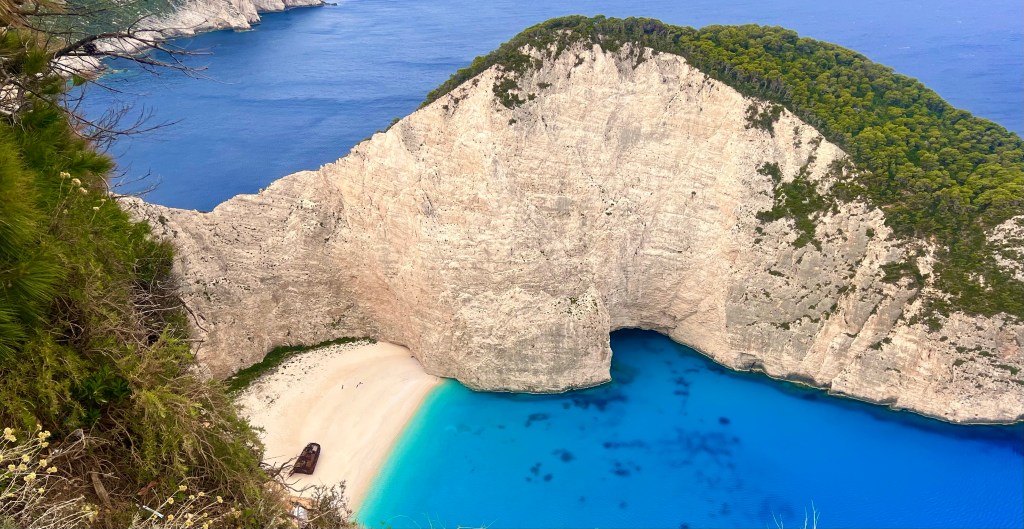
If Laganas proves just how spoiled places can become, Navagio Beach – home to the famous shipwreck – shows the opposite. The beach is untouched by human hand due to an earthquake in 2022 making it too volatile and unsafe to enter onto. Instead, you can only view the beach and shipwreck from high in the mountains (as we did) or by taking a boat excursion and seeing it from the water.

This secluded cove up in the north of the island is more commonly known nowadays as ‘Shipwreck Beach’ or ‘Smugglers Cove’, although it was formally known as ‘Paradise Beach’ before something extraordinary happened…
In 1980, a ship called MV Panagiotis encountered severe stormy weather and ran aground in the cove of Navagio Beach, where the crew abandoned the vessel. Rumour has it that the ship was carrying contraband cigarettes from Turkey to Italy, when it ran into stormy seas and lost power. The captain had deemed it better to ‘jump ship’ and abandon the vessel, rather than face the Naval Authorities, who were apparently hot on their tail. Another rumour is that the ship was also carrying people, illegally. Now, the remains of MV Panagiotis sits buried and rusting away in the sands of the cove and each year, with each bout of turbulent weather, erodes some more.

If I look at the postcards and compare their images to my own, it’s evident that the shipwreck has suffered extensive damage and is gradually disappearing away before our very eyes. How much longer will it be there? Not long, apparently – so see it whilst you can….
It’s little wonder this is one of the most photographed sights in Zakynthos – and throughout the whole of Greece, for that matter. It really is spectacular and I’m still kicking myself for not taking my ‘proper camera’!
Volimes
Close to Shipwreck Beach is the picturesque little village of Volimes, which we drove through to get to and from the Shipwreck.
Although it is reportedly the largest traditional mountainous village on the island, you can be forgiven for feeling like you have gone back in time, where there are very few houses, one – possibly two – little stores and barely a soul in sight.

At least, that’s how it was on a cloudy day in May, just at the start of the tourist season.
Apparently the village comes to life in the summer months, with all sorts of stalls popping up along the streets, with locals selling honey, olive oil and other traditional goods. As with Cape Keri, a drive through Volimes means having the wit and wisdom to negotiate super-narrow streets – and get out alive.
Zakynthos Town
Last but not least – the island capital. Zakynthos Town is the hub for island-hopping ferries, private yachts and commercial activity.
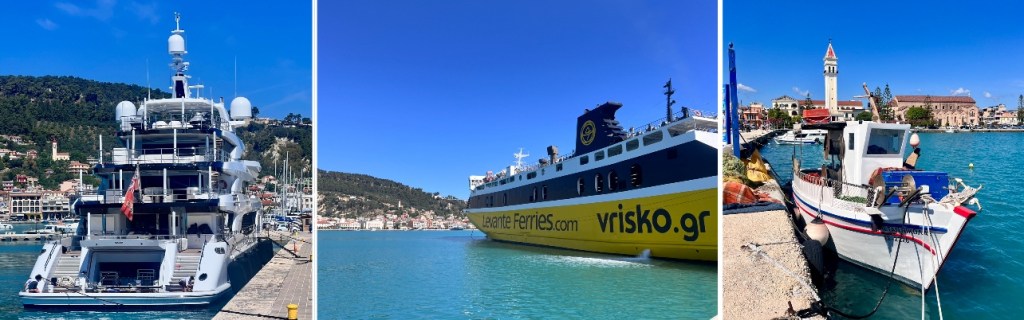
If you dream of a life on the ocean wave, you’ll love a walk around the port to indulge in some super-yacht envy. Some of these vessels are absolutely massive and have a full crew of hard-working deckhands polishing every inch of the three stories ahead of setting sail. How the other half live!
There’s a bustling town centre behind the port, which offers shopping galore and lots of places to grab a meal. It was rebuilt in a Venetian style following an earthquake in 1953.
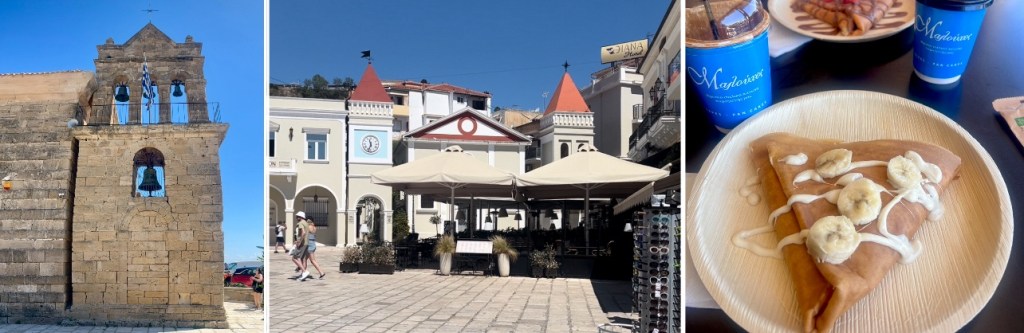
The church of Agios Nikolaos Molos, located in Solomos Square, is also the only building of Venetian design that survived the earthquake and which keeps its original characteristics. The town generally has a modern feel, especially when compared to the rest of the island. This might be why almost half of the population of Zakynthians choose to live here.
It might also be why parking can be problematic for people, especially when ‘double parking’ is a ‘thing’ here! Fortunately, we didn’t fare too badly – though again, we are taking a May Monday as opposed an August Saturday.
Road wars aside, Zakynthos Town is a must for anyone visiting this gorgeous Greek island. Ok, so it lacks a beach, but so what? Venture 10 minutes up the road to Argasi if you still crave that!


 Sun, See and Suitcase
Great insight into Zante… seems a great place to visit .
LikeLike
This looks a lovely island and most definitely worth a visit sometime! The colour of the sea is fantastic- your pictures do it justice. Well worth reading this blog full of information and recommendations.
LikeLiked by 1 person