
As the furthest island east of the Mediterranean, Cyprus has a subtropical climate that almost always guarantees sunshine – which is why it is a fantastic holiday destination!
I’ve visited Cyprus 3 times now and each has been different than the last, for example, the south is very different from the north, as I’ll explain…
Southern Cyprus
For Cyprus with a Greek influence, visit the south! It’s here where you’ll find the best food, the prettiest villages and the friendliest Cypriot folk.
We wanted a last minute week away with a caveat – short haul, hot (obviously) and somewhere that would allow us to unwind from the daily slog for a while. We stumbled upon a sleepy little village in Southern Cyprus that fit the bill just perfectly.
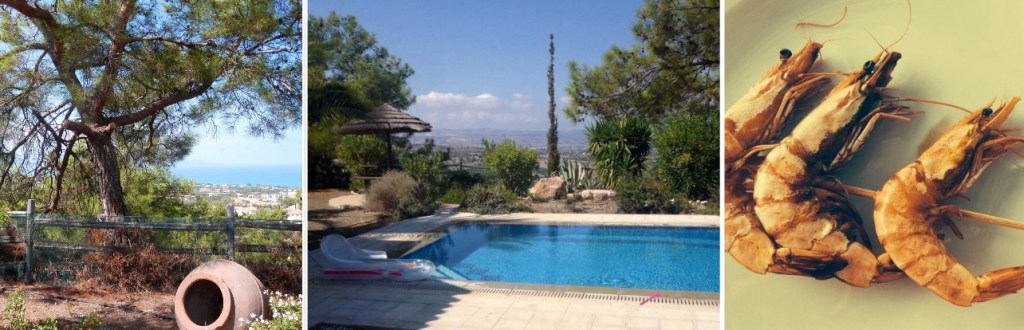
Less than an hours drive from Paphos Airport (around 40km) and way up in the hills and pine forests, Argaka was close enough to save on an overly lengthy car journey upon arrival (never a good thing), yet far enough to leave the all-inclusive mecca of central Paphos behind.
This section of the blog focuses on the west of southern Cyprus only. Clearly there’s much more to be explored which I’ll do…another time.
Argaka and Polis
Argaka is a traditional farming village built into the mountains and with amazing views of the sea below. We struck gold with our rental villa (Mediterranean Coast View Villas) which overlooked the turquoise seas of Chrysochou Bay. The villa itself was spacious, clean, well equipped and boasted a huge private swimming pool and built-in BBQ that was ideal for lazy ‘pool days’ when we didn’t want to venture out.
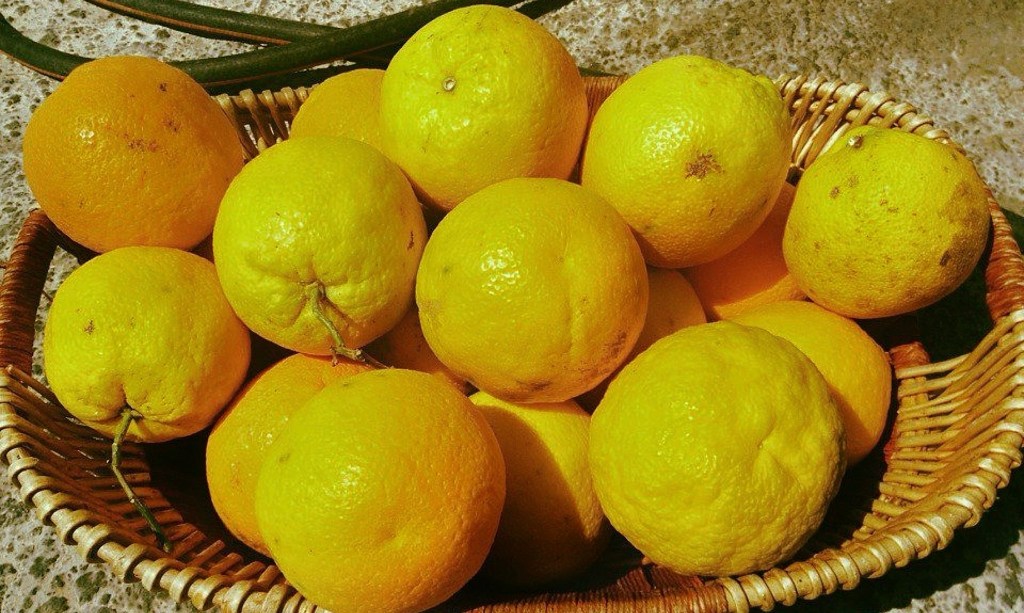
The owner had also kindly picked us a basket of juicy lemons from the garden outside as a welcome gesture, just perfect for those all important G&T’s in the beating sun!
A small shingle/ sand beach was within easy reach of our villa (5 minutes by car, 30 on foot) and stretched along the Akamas Peninsula, with the occasional beach bar from which to grab a snack and an ice cold Keo beer to help quench our thirst in the heat! Because it’s a little village, the beach doesn’t get crowded, which is always a bonus.
Polis is the nearest town to Argaka and just ten minutes away by car. It’s the most rural of the larger holiday resorts in Southern Cyprus and the word ‘Polis’ translates as ‘city’. Although much bigger than Argaka, Polis is hardly what you’d call a city, more of a small, quiet, traditional town. Despite being so unassuming, there is just enough in Polis to keep it ticking along nicely. And that’s what makes it so nice.
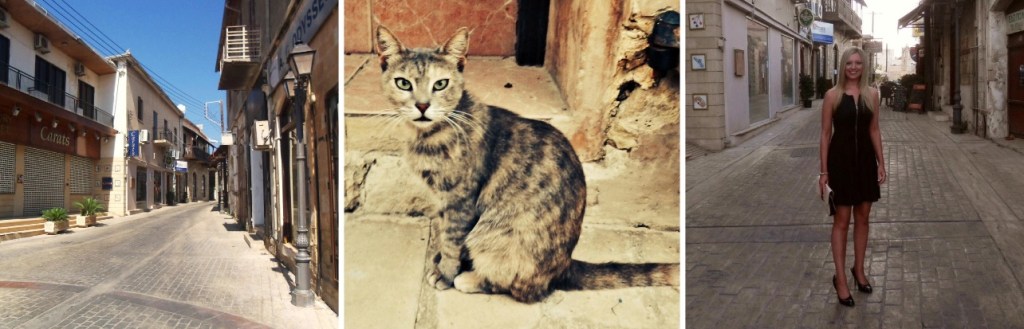
As any tourist town should, Polis offers a sizeable supermarket (great for those bbq essentials), a handful of souvenir shops and a number of cosy tavernas, complete with the obligatory feral cat, of course! And what town would be worth its (sea)salt without a number of watering holes too? Vital really, to refuel after a day in the scorching Cyprus heat!
And what is better than alfresco dining in the evening sun? Not a lot. It goes without saying that the Greek-influenced cuisine in Cyprus is truly a foodies dream – delicious mezes to share, fresh Greek salads and as much seafood as the heart desires! The traditional breakfast of Greek yoghurt and fruit is delicious (and healthy) too! I could go on forever, I’m a big fan of the Greek-Cypriot food.
We ate in Polis most evenings (and sometimes for breakfast) and there was an expansive choice to fit whatever took our fancy on any given day. Chix Chox taverna was perfect for casual beers and cheap eats, with a lively atmosphere to boot. By contrast, and just a few strides down the road, Finikas did tasty traditional food, set in a gorgeous walled courtyard that was covered in wild flowers. It served generous servings of the best dolmades and mousakka I had ever tasted!

As is tradition in Southern Cyprus, after your meal you’ll be presented with a shot of ouzo, ‘on the house’. Not my favourite, admittedly, but a nice touch from the restaurants nonetheless. If cocktails are more up your street, Polis also has a number of cocktail bars serving cheap-but-deadly concoctions that may tempt you, as they did us!
Latchi and the Baths of Aphrodite
The beach at Polis stretches for miles from a eucalyptus forest down to the fishing port of Latchi – a 10 minute drive by car. Latchi is a popular spot, with a nice sandy beach, a pretty marina and a working harbour. Although small in size – like Polis – Latchi is well worth a visit if you have a hire car and can get to it. Here you can sit and savour a delicious lunch at one of the harbour-side restaurants, whilst partaking in some boat-watching whilst sipping a Pina Colada! Food fresh from the sea is always a winner and coupled with a cheeky afternoon cocktail, even more so.
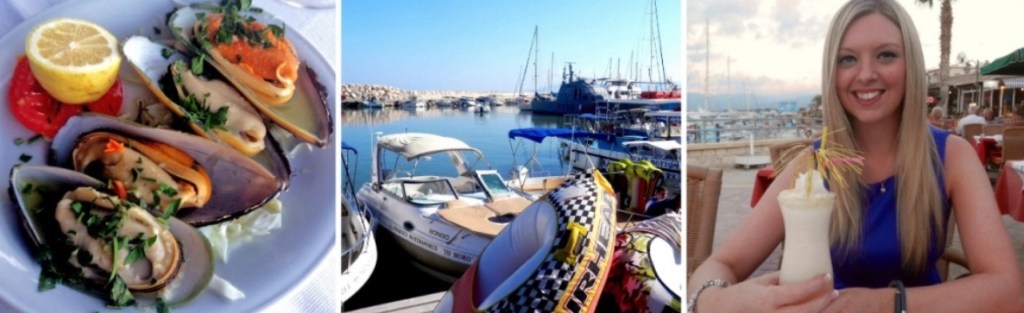
You can catch a number of boat trips from Latchi too. We took a 3 hour trip around the peninsula and whilst pleasant, did feel overly lengthy as it spent more time sat stationary in the ocean. This might be ideal for those who wanted to swim, but not so ideal for me who didn’t (I should have paid more attention to the itinerary!). If nothing else, the trip provided some shelter from the midday sun and the opportunity to hear a load of Eastern European tourists sing ‘Zorba The Greek’. Badly. Repeatedly.
Boat trips from Latchi also go out to the Blue Lagoon for a full day trip, should you so desire – again with some swim-time factored in.
As well as the beach, Latchi is not short of hiking trails if you’ve packed your walking boots and want to be ‘at one with nature’. The island has lots of interesting flora and fauna that you wouldn’t ordinarily see back at home, too.
Well worthy of a visit is the Baths of Aphrodite, where a winding trail through woodland leads you to the spot at where Aphrodite, Goddess of Love and Beauty, used to bathe in the pool of the natural grotto. Follow the path all the way from the car park and you’ll find yourself suddenly in front of the cave and pool. This is so well-renowned in Greek legend as the place where Aphrodite met in secret with Prince Akama’s of Athens.
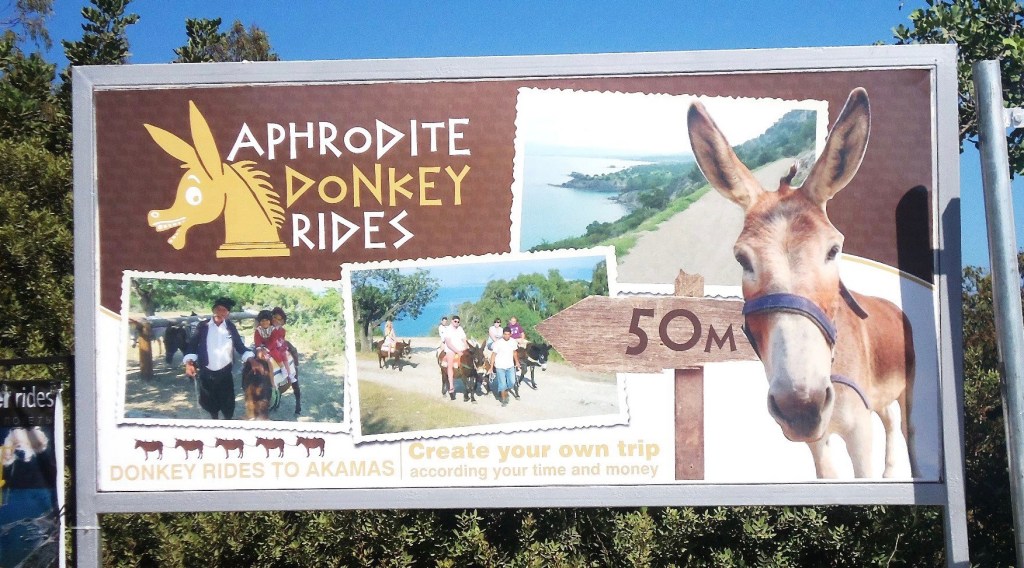
Although the walk to the bathing pool is free, don’t be at all surprised to see offers of donkey rides – and even helicopter rides – keen to cash in on the tourists visiting the Baths of Aphrodite!
Paphos
On the whole, Paphos is extremely commercial (by contrast to Polis), with gift stores galore, all-day happy hours and McDonald’s – not that this is necessarily a bad thing, just less traditional.
Paphos really started to take off in the 1980’s when all the hotels began being built – and it’s not looked back since! You can see why Paphos is a tourist hotspot, attracting couples, groups and families who want a beach break with everything in one place and without requirement to hire a car and explore. It all comes down to what sort of a holiday you want – rural, removed and real – or cheap, cheerful and convenient.
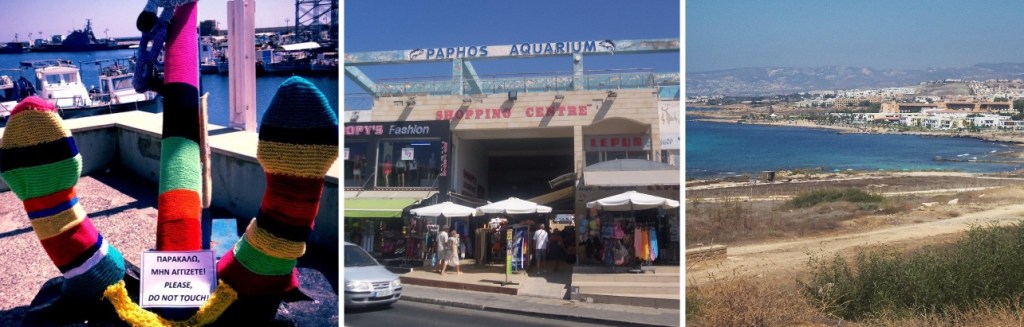
Aside from the high rises and party-town, Paphos has an ancient town, which feels almost as though it is split into two very different and distinct areas. As such, Paphos is steeped in history with ancient and medieval buildings, rock tombs and mosaics – some of which date back to the 3rd and 4th centuries.

These mosaics can be viewed at the House of Dionysos and include a huge depiction of a wine harvest, which is possibly the main attraction there. The mosaics were only unearthed in 1962, when the insight into ancient mythology was exposed pictorially. Since the discovery, Paphos has become something of a huge archeological site that attracts huge numbers of people keen to see it for themselves.
North of Cyprus
If you want Cyprus with a Turkish influence, visit the north! With super sandy, unpopulated and remote beaches, you can find serenity here that you can’t so easily in the south.

Having visited the south twice previously, we found ourselves in the north for a change – more by chance than choice. A friend had offered us his super-swish villa for two weeks at ‘mates rates’ – so it was too good an offer to pass up – and I love to explore new places!
The super-sized villa with sea views and the sunny 25 degree September weather were perfect for our escape! You’ve perhaps gathered that my preference is to stay in villas when I can, given you get lots of space all to yourself and amenities for making your own food and washing your own clothes (great if you prefer to travel light and save space for souvenirs).
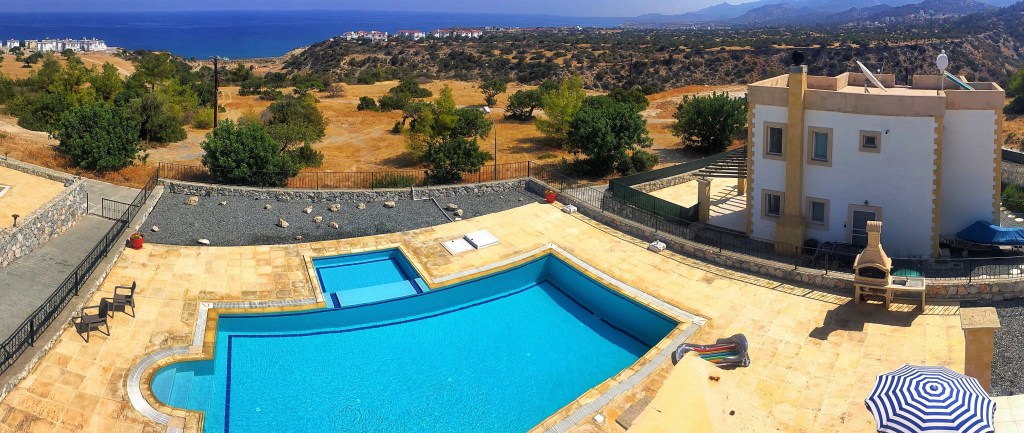
Getting to our villa was not especially straightforward, however. Since the north is rather more remote and off-grid than the south, it was necessary for us to fly direct into the southern airport of Larnaca, over an hour away. But this added journey time wasn’t the main issue.
Crossing the ‘Green Line’…
From the airport, we had been advised to hire a private car that would take us across the border into the north, as this was deemed to be easier and safer. The journey meant crossing the Green Line – essentially a demilitarised buffer zone guarded by United Nations peacekeepers. This was originally put in place in 1974 as a temporary measure to restore peace, but has remained in place ever since. Far removed from any other ‘Border Control’, this was little more than a small hut in what felt like the middle of nowhere.
We had to give our passports to the driver to present to the officials, as well as to have our luggage checked over. It was a strange experience and a little unnerving, if honest.
Did you know? Between 1974 and 2004, visitors to Cyprus were only allowed to visit the north on a day trip, which meant a long and convoluted journey via Turkey! This all changed with the admission of Cyprus to the EU in May 2004, thank goodness!
Famagusta
Our base for the fortnight was up in the hills, just outside of Famagusta – a once popular holiday haven with Hollywood film stars, due to it having the finest stretches of sand in the Mediterranean – apparently. Prior to that, it was the most important place on the island during medieval times, when it grew enormous wealth through trade coming into and out of the port.
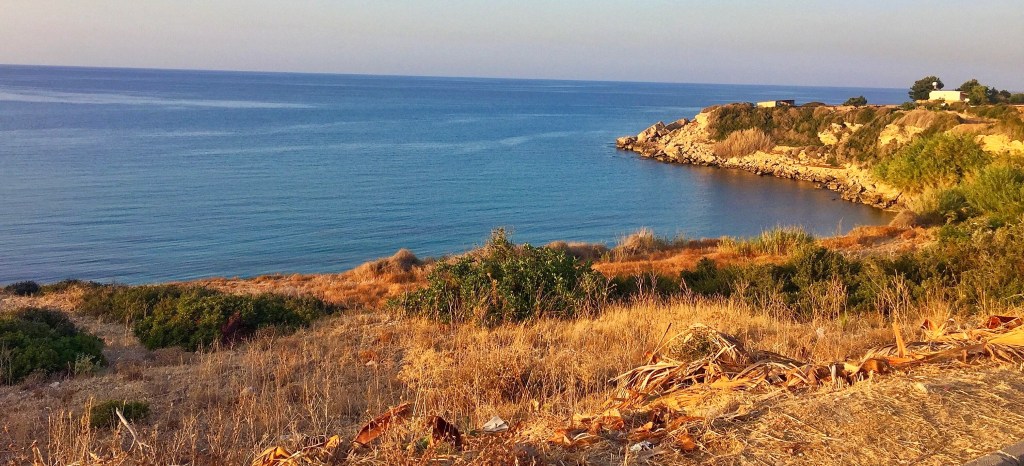
Nowadays, Famagusta is more of a quiet, sleepy village on the east coast, with the main claim to fame being the deepest harbour on the island. Despite it having ‘let itself go’ somewhat, it remains one of just three towns in the whole of the north of Cyprus!
Although limited in things to do – aside the once-award-winning beach – there’s just about enough places to dine out, albeit all of them a drive from our hilltop position, as opposed a leisurely stroll. Here the food has a strong Turkish influence, consisting of lots of small ‘sample sized’ plates, kebabs and – with it being on the coast – fish dishes. All very tasty and traditional, with most owned and run by families. Interestingly, the clientele appeared to be more British Expats than anything else.
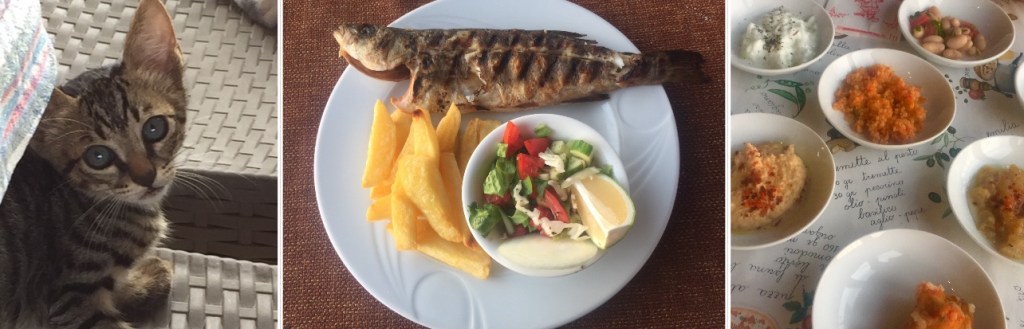
As in the south, feral cats begging for scraps were a commonality wherever you ate – and whatever you ate! You will also hear the call to prayer from almost wherever you are each day and evening, which only adds to the whole cultural experience.
If you plan to stay in Famagusta, I’d say hiring a car is essential if you can’t cut it sunbathing all day, everyday – or you’d like to see more of the northern part of the island. We hired a car cheaply and easily in the resort itself to do just that.
Girne (Kyrenia)
We took a drive to Girne (also known as Kyrenia) which took around 45 minutes from Famagusta. This is the most popular tourist hub in the north.
I say ‘Girne, also known as Kyrenia’ because places in northern Cyprus often go by different names – one being the original Greek name and the other, Turkish. Since I’m writing about the north, I’m going to opt for using the Turkish names first.

It’s quite obvious why it’s the number one spot when you arrive; Girne is a picturesque harbour town with a Venetian castle (named ‘the Jewel of Cyprus’) and more souvenir shops, bars and restaurants than you can shake a stick at. Quiet, it is not! Girne also has numerous hotels and casinos, three universities and a decent nightlife – pretty big by Northern Cyprus standards, let alone Famagusta!

For anyone missing a taste of America, there’s even a good old fashioned Burger King (next to the rip-off Louis Vuitton bag stall) to tantalise the tastebuds. Indeed, if fake designer goods are something you dare smuggle home with you, Girne is the place for finding them!
But seriously – Girne has a lot of charm and character, coupled with a gorgeous harbour that’s picture-perfect.
Lefkosa (Nicosia)
25 minutes on from Girne by car, Nicosia has been the capital of Cyprus for the last ten centuries. It is known as the ‘Walled City’ as it is the very last ‘divided city’ in Europe (following the fall of the Berlin Wall in Germany).
One half is Lefkosa (Turkish) and the other, Nicosia (Greek) – sectioned off by the buffer zone again.
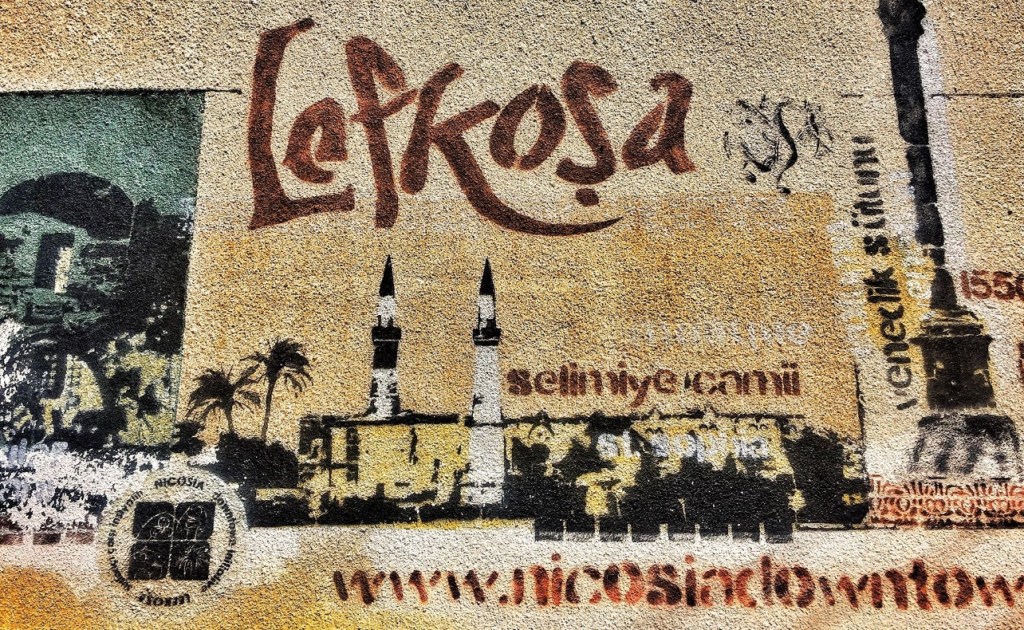
Despite the divide, tourists are able to cross between both sides without problem, given a lack of cross-border restrictions (unlike our journey from the airport to the villa).
As you wander around you see the clear differences between the north and south areas, with the former being quiet, somewhat run down and rustic and the latter, more lively, modern and colourful. One central point where the two halves collide is a municipal bazaar right on the boundary, which has been going since 1932.
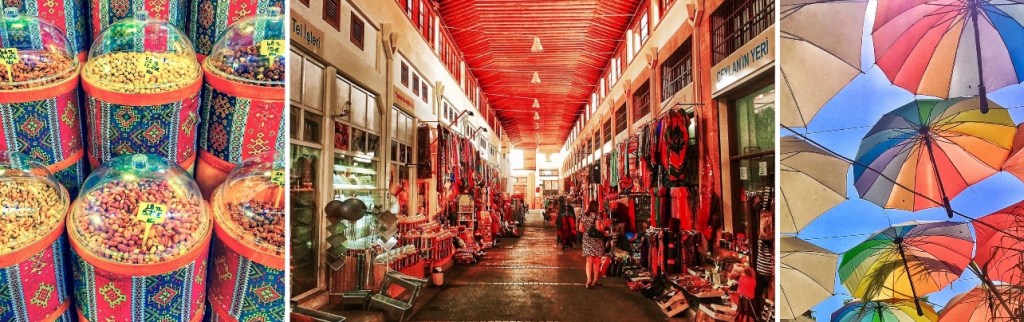
It really is a feast for the senses. Here you’ll find all manner of delights from Greek citrus fruits to Turkish tapestries, as well as a whole host of food stalls serving both cuisines. As such, the bazaar is a lovely place to sit and people watch, whilst enjoying a spot of lunch or an afternoon drink…under bright umbrellas, no less. You can – quite literally – go shopping and eating and pay with Euros and Turkish Lira at the same time.
Any trip to northern Cyprus would be incomplete without visiting the ‘Walled City’ and experiencing the unique culture of a small city divided.
Karpaz Peninsula
A two hour drive east from our base in Famagusta, we reached the Karpaz Peninsula. Here we found stretches and stretches of golden beach, entirely unoccupied and completely to ourselves. This demonstrated that the wilderness of the north that had previously felt a little too quiet, could actually feel quite lovely too!

As you leave the beaches, you begin to venture into the Karpaz National Park – quite a baron place that is home to farmers, the Karpaz donkeys and little else. With barely a person or car in sight for miles, a drive to the very end of the Peninsula saw us greeted instead by the local donkey residents, who did not seem to want us to pass easily! Acting like keepers of the kingdom, they sauntered up to our car window and took a good look at us before reluctantly moving out of the way. Quite the attitude (or ass-itude).

With the Peninsula being a fair way out from Famagusta, we decided to stay overnight. The lovely ‘Villa Lembos’, a sweet family-owned B&B, had come recommended to us. We enjoyed a fantastic self-contained chalet with our own little garden space where we were able to savour a well earned tin of the local Efes beer before our evening meal…Serefe!
Prior to the Turkish invasion of Cyprus in 1974, the peninsula (notably a town called Rizokarpaso) was predominantly inhabited by Greek Cypriots. When the invasion happened, the peninsula was cut off to prevent them fleeing to the south. Interestingly, it is only here that both Turkish and Greek Cypriots still live together, without conflict or division lines.
Only time will tell if Cyprus will ever see a break in the dividing line.
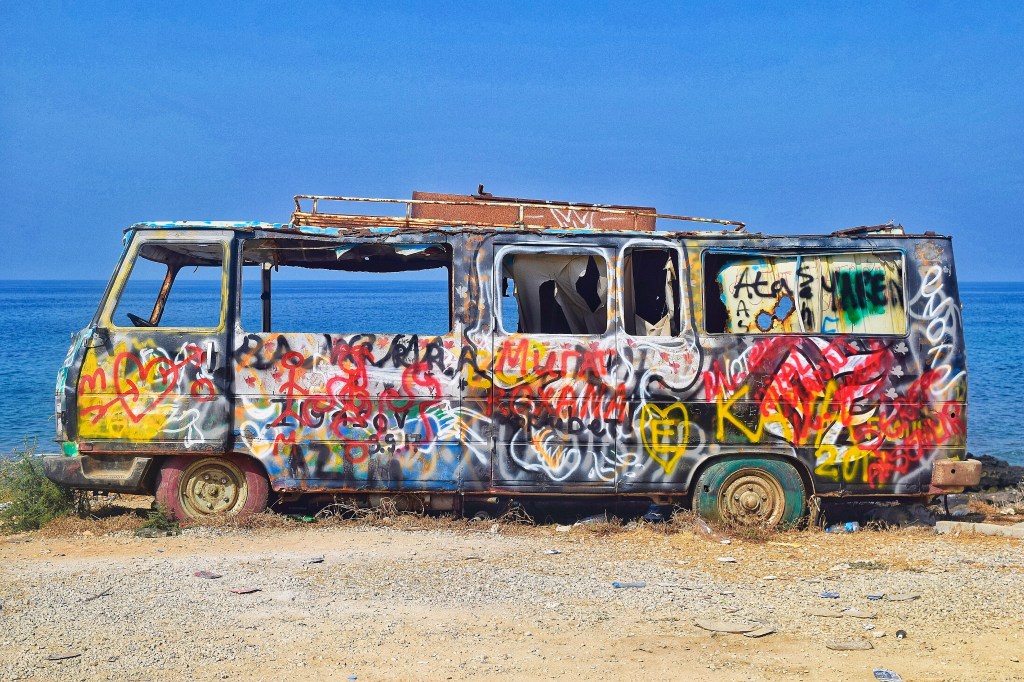
North versus south? What wins? Let me know in the comments below 👇🏻

 Sun, See and Suitcase
I’ve never been to Cyprus, but the North sounds appealing with the mix of Turkish influence🤔
LikeLiked by 1 person
Good info- great place to visit looking at your blog .
LikeLiked by 1 person
Very interesting read and good to know info before a trip out there.
LikeLiked by 1 person
Great read, thanks for sharing.
LikeLiked by 1 person
Excellent insight Lynsey. Really enjoyed it.
LikeLike