
Part of the ‘Exploring Cornwall’ blog
The ‘Wild West’ of Cornwall is generally quieter than the north and south coastlines and as such, it attracts the walking and camping crowd who come here for the craggy headland, ancient moorland and views to die for. We managed to see Penzance, Lands End, the Lizard Peninsula, Mousehole, Porthleven and St Ives.
When exploring the west of Cornwall, we stayed in Penzance so when you get to that part of the blog, you’ll find some helpful tips on where to eat and drink as well.

Lands End
Lands End is literally the last stop in the UK before you drop off a cliff and fall into the Atlantic Ocean!
It’s the final destination – or first port of call depending on your direction – on the UK’s longest road trip from John O’Groats to Land’s End. As such, it came as no surprise to see groups of cyclists taking selfie’s to prove they had either finished the trek or were setting off on it. Rather them than me.

As a ‘tourist attraction’, in honesty, there’s not a great deal to see at Lands End any longer, other than a few overly-expensive gift shops and some pretty naff looking children’s entertainment.
Although there’s no admission fee into Lands End, the famous landmark sign post is now controlled by a company that charge a hefty fee for a photograph alongside it. It’s all a bit of a shame as I vaguely remember spending a good and full day out at Lands End as a kid in the 90s.
My advice – pay it a visit but go with low expectations. Also – here’s a tip – don’t park up at Lands End and waste money on pricey parking costs. Instead, park a mile and a half at Sennons Cove and walk in and out. Not only will you save yourself some holiday cash, but you’ll also get to enjoy a nice walk along the cliffs, with stunning panoramic ocean views instead. Don’t miss the shipwreck midway either.

The Lizard Peninsula
Whilst on the theme of walking across wild and craggy headland, a favourite spot with walkers and campers is The Lizard. For someone who has an irrational fear of lizards and all things reptilian, I wasn’t sure I trusted the name. Turned out that I needn’t have worried….not a gecko in sight!

Perched on the Lizard peninsula is the well-known Kynance Cove. It is usually a gorgeous spot if you love a white sandy beach and turquoise waters. You only need to check out the rafts of Instagram photos out there are out there to see how popular a spot it is. However, we happened to visit The Lizard on a day that was more than a little wild, with raging winds and driving rain battering down – the crystal blue waters replaced by thick, brown foam (not Insta-worthy).
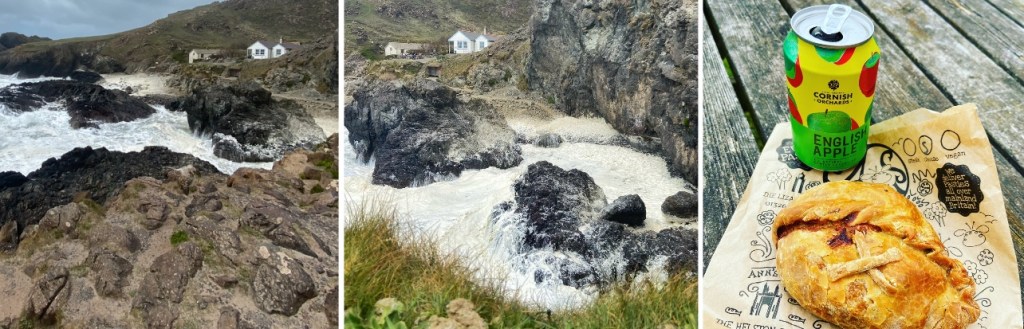
Like all of the coastline in the west of Cornwall, you can walk for hours on The Lizard, if that’s what your heart desires. You could holiday all week here and still not run out of paths – and many do, in tents!
Needless to stay, the elements put stop to us doing any of this. Instead, we heading into the super-small town and found one of the best pasty shops in Cornwall – Ann’s Pasties. And it’s not just me who says so – apparently Rick Stein is a huge fan! So it must be true. The good old Cornish pasty even has protected status – treasured in these ‘ere parts!
Mousehole
Who can resist a town named Mousehole? But it’s not pronounced as it sounds, if you want to speak like the locals, it’s Mouwzal…
Unlike some of the villages on the west coast, Mousehole (and St Ives – but more on that later) look like they belong more with the chocolate-box-society of south Cornwall. They’re just that darn pretty!

With seaside cottages, winding lanes and an old granite harbour, Mousehole is a little gem of a place. Little being the word. But despite being only titchy tiny, with a baby-sized handful of eateries and independent shops, it’s a must-see in my humble opinion.
For anyone who has a dangerously sweet tooth (like me), I think there’s no better place to stop and enjoy a delicious, traditional Cornish cream tea by the harbour side. We did and it was up there with the best! In Cornwall, the rule of thumb is that jam goes onto the scone first, clotted cream last. If you’re in Devon, it’s the other way around. It’s honestly one of life’s greatest debates, but I will say this – the correct way is cream first, jam second.

If your inner Big Kid makes an appearance, be sure to purchase a ‘Tiny mouse of Mousehole’ (they’re a thing) to take home and fondly remember your visit to this cutesy place. Don’t listen to partners who ask why you need more ‘clutter’.
Penzance
Arguably, Penzance is right up there in the top five most famous Cornish towns, known (if only in name and reputation) for mystical myth and adventure! We stayed in a lovely, cosy cottage in Penzance for eight nights during our Cornish break as it seemed to be the most central spot from which to go exploring.
Penzance is the UK’s most southerly town and an old haunt of smugglers and pirates. Most of us are aware of the ‘Pirates of Penzance’ film, however the real piracy stories dating back to the 18th Century are far more sinister, which saw pirates invading the town and taking men, women and children as slaves, only to then be sent over the waters to North Africa. Eventually, the UK combined with America to put stop to barbaric piracy, although the process was too slow to save many.

Nowadays, Penzance is a town that has a relatively busy shopping centre, a culture of art and crafts and boasts impressive Georgian architecture – a place where old meets new. Transport links are readily available from Penzance too, with a ferry port transporting people all the way over to the Isles of Scilly and a train station taking folk as far as London, should a day trip to the smog be on the cards!
Apparently, Penzance is usually a hothouse and enjoys a balmy subtropical climate. This definitely did not feel the case during our stay in what turned out to be one of the wettest May’s on record, but I’m assured it’s usually the case! There is an outdoor public garden in the centre (Morrab Gardens), housing exotic plants and trees from North and South America, North Africa and Australia, which acts as proof.
If you have your walking shoes at the ready, Penzance provides many walks directly from the harbour and along the coast. We opted to blow away the cobwebs on a Sunday morning and stroll along the Victorian promenade, routing through the fishing village of Newlyn and onto Mousehole. The walk takes around two hours there and back and means you’ll catch a glimpse of the famous pebbles and the Penlee Park Open Air Theatre. You’ll also see the giant fisherman statue, paying tribute to all those lives lost at sea (you forget sometimes how dangerous a profession deep sea fishing can be). Penzance is clearly proud of its history with the sea and parts of the bay are designated conservation zones.

The route will also take you past Penzance’s ‘Jubilee Pool’ – Britain’s longest surviving seawater lido. It provides a place for swimmers to safely train in the sea when the conditions may otherwise be too dangerous – and also has a smaller pool away from the swim lanes that anyone can use. My excuse: too cold at 9° on land, let alone sea temps!
Of course, walking (and no doubt swimming) will work up a thirst and appetite – and we did plenty of essential ‘research’ on the local eateries and drinking houses during our stay! Here’s a few top picks:
The Admiral Benbow pub has been in existence since the 17th Century and during its time, has received fame for appearing in the opening scene of ‘Treasure Island’. It has also welcomed famous guests such as The Rolling Stones and Gregory Peck. Today, it is set out as though you are on a boat, complete with reclaimed decor from shipwrecks such as figureheads and anchors. It could be argued that it’s a tad tacky, but nonetheless it’s a must-visit!
The Turks Head is also a pub that you should visit as it’s the oldest in Penzance, having been in situ since the 13th Century, when it allegedly housed a smugglers tunnel leading directly down to the harbour. Equally historic, the Dolphin Tavern is one to check out as it was allegedly the tavern that Sir Walter Raleigh first smoked tobacco on English soil (and it serves a mean burger and chips!).
As for eating, you can’t really go wrong with ‘The Old Lifeboat House’ purely for its interesting surroundings and ‘The Artist Residence’ for quirky dishes in gorgeous rooms. But just topping the lot was ‘Mermaid Alley’, an intimate little place, themed to the nines and serving excellent mackerel pate and seafood chowder – not to mention cocktails to sink the sturdiest sailors!

Penzance really is a fascinating place to visit whilst you’re in the West of Cornwall. I won’t lie, it’s far from polished and far less pretty than many other parts of Cornwall, but in turn, you could say it’s more honest and real.
Porthleven
As one conversation on food neatly leads into another, we dropped into Porthleven purely to sample the delights of Kota Kai for lunch – one of two restaurants owned by the new ‘celeb chef on the block’, Jude Kereama.
O-M-to the G was this tasty food! I opted for some light bites – the asparagus arancini with wild garlic and the duck bao bun with hoisin and peanuts – which I washed down with a ‘Pure Passion’ cocktail. Craig opted for a more traditional plate of fish and chips – posh style, of course!

It was a rainy old day in Porthleven unfortunately, so we didn’t stay long – even the local cats looked pissed off at the incessant downpour! We did, however, have a quick walk around and noticed that yet another TV chef, Michael Caine, has a restaurant here too. Expect to see Porthleven contend with Padstow in the foodie wars in the future!

St Ives
Let’s finish my whistle stop tour of the West with a true beauty spot!
If Newquay is Cornwalls ‘Capital of Surf’, then St Ives must be the ‘Capital of Pretty’? It is also the heart of the art scene and the only place in Cornwall to have a Tate Gallery. Here’s one for the pub quiz under the category ‘useless information’ – famous sculptor and artist Barbara Hepworth set up studio in St Ives the 1920s, where she later died in a fire when she was in her 70s.
When you see how gorgeous St Ives is, it all falls into place as to why it’s an artists playground.
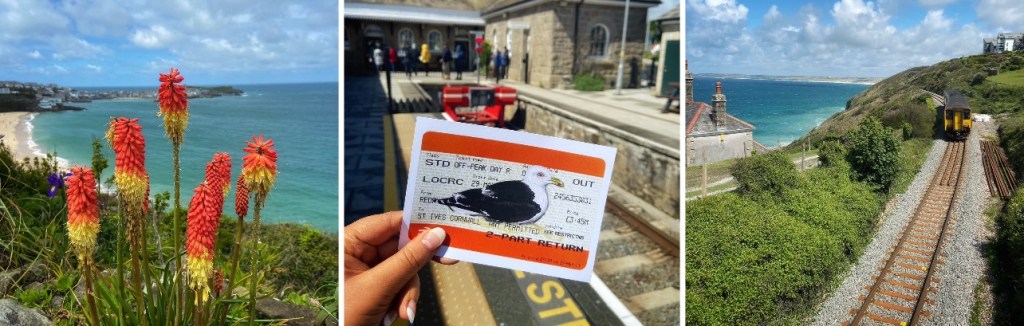
For a different experience, we decided to take the train from St Erth to St Ives as I’d heard that it’s one of the prettiest train rides the UK has to offer, offering stunning views across Carbis Bay, Porthminster Point and St Ives itself. Not to mention, it would save battling for a car parking space in St Ives too! The rail journey only took 15 minutes and cost very little for the privilege.
Once reach St Ives, you’re met with a jumble of cobbled streets lined with galleries, cafes and shops to appease the tourists. And it’s quirky too. You’ll see some interesting street names such as ‘The Digey’, ‘Salubrious Place’ and Teetotal Street’ (couldn’t live there). Art comes through at every corner as you’d expect, from the proper galleries, to inventive window displays and tattoo parlours for those wanting to art themselves.
When we arrived at St Ives the tide was out at Porthminster Beach, meaning that we were able to walk across the sand to get into the town. Just two hours later as we went to leave, the tide was fully in. Who knew it worked so fast?
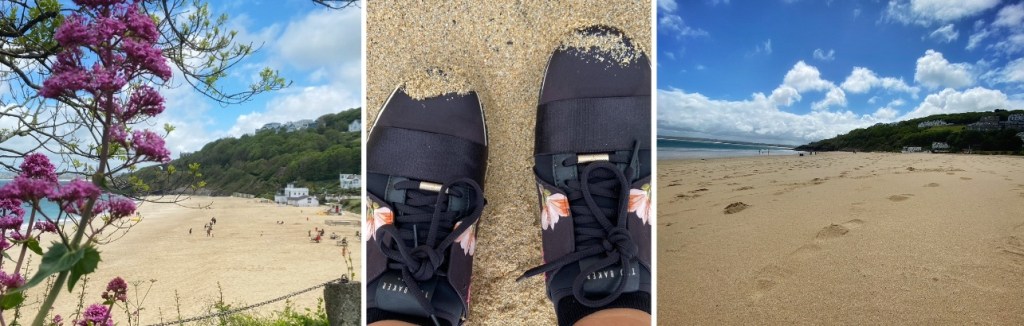
We decided to stretch our legs (after yet another afternoon tea at my request) and walk part of the journey back to Carbis Bay train station. The sun even made a welcomed appearance, making the views in this pocket of Cornwall even more spectacular!


 Sun, See and Suitcase
Lynsey- you really should do this for a living! You describe an area of the country which I know very well( we are going there next week) and your appreciation of the towns and villages and the way you describe them is brilliant. Keep them coming!!
LikeLike
Lovely photos -and the food sounds great!
LikeLike