
How do I describe North Wales? Coast, castles and charm. That’s how. From the wild wilderness of Anglesey, to the nostalgic Llandudno and picture-perfect Portmeirion, it’s fair to say that North Wales is somewhere everyone should venture to if they can.
Croeso i Gymbru! (Welcome to Wales)….
Anglesey
Surely every holidaymakers’ favourite place in North Wales, Anglesey is the land where time almost forgot and where less is most definitely more. If you want a complete break from towns and cities, you’ll find it here.

Anglesey is North Wales’ biggest island and consists of 276 square miles of beaches, coastline and lush landscapes – much of it awarded the prestigious title of ‘Area of Outstanding Beauty’. It’s little surprise that people from all across the UK head to Anglesey to either go walking, cycling or to partake in a bit of bodyboarding!
We stayed in Cemaes Bay, the most northerly point of the island and home to a pretty little fishing harbour set beside a handful of pastel coloured cottages. There’s not a great deal to do here other than pay a trip to the beach or sample the delights of a couple of pubs. There’s a decent fish and chip shop too. But going back to basics is what many people escape to Anglesey for – simple, quiet calm.
We toured around almost the entire island during our weekend trip, which really wasn’t difficult in a car as it’s not huge. We made sure to take in the best known sights and scenery – and were really lucky with the weather too.

Rhosneigr, on the west, is one of the most visited and well known spots on Anglesey. It attracts both the surfing set and well-to-do holiday-homers with its impressive sandy shores and a community of nice restaurants and boutique shops. It’s also a haven for walkers/ hikers too.
Also on the west coastline (north west) is the South Stack Lighthouse – standing boldly on a jutting piece of cliff. It’s 400 steps down to the lighthouse from Holy Island and the car park at the top – and a very steep climb back up to the top. Given it was rather windy when we visited, we ‘spectated from above’. Cop out, I know. Wildlife is abundant here and we spotted some seals swimming in the water as well as nesting birds (in their masses) high up on the surrounding cliffs. If you need to stop for a coffee and sandwich with a panoramic view, the nearby RSPB visitor centre at the car park has a really nice cafe. Sea, sandwich, sorted.
On the east coast, the most visited town is Beaumaris (meaning ‘beautiful marsh). It is regarded as being Anglesey’s prettiest village, which is definitely evident when you see it. Whether you stay here or just visit for a few hours, you can enjoy a World Heritage Site castle (small fee to get in), a handful of hotels, plenty of cute shops selling unique bits ‘n’ bobs, nice places to eat, art galleries and. a lovely waterfront complete with a pier stretching out into the sea – perfect for catching rays and glimpses of dolphins (if you’re lucky).

Also on the eastern coastline is Benllech, another popular holiday location for beach goers (it’s Blue Flag awarded too). Word has it that the beach got its name after a Viking battle which drenched the beach in blood – not so nice.
Did you know? Holyhead – the largest town in Anglesey – operates Irish Ferries trips that will ship you over to Dublin in a mere 2.5 hours!
And another fact….The famous train station with the longest place name in Wales – Llanfairpwllgwyngyllgogerychwyrndrobwllllantysiliogogogoch – is on Anglesey. This translates to ‘The church of Mary in the hollow of the white hazel near the fierce whirlpool and the church of Tysilio by the red cave’!
Llandudno
I’ve been visiting Llandudno since before I could walk! As a family, it was a holiday favourite with a beach, a promenade, a pier of amusement arcades and an old-fashioned Punch and Judy show!
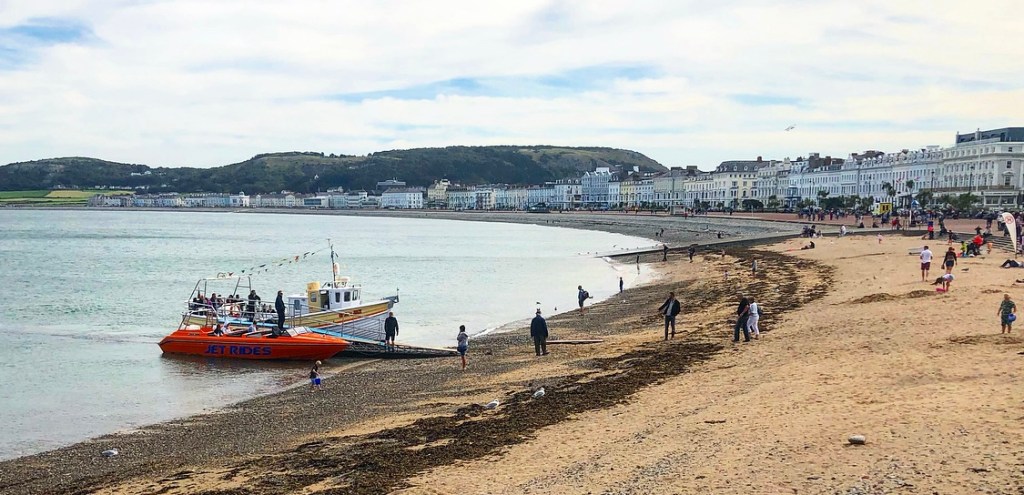
Llandudno (pronounced clan-did-no if you’re wondering) is a coastal town famed for its Victorian architecture, the rugged cliffs of the Great Orme, a history-packed pier, cable cars and traditional trams! It is also the largest seaside resort in North Wales and the number one hotspot since the 1850’s. Nobody goes to North Wales without having visiting Llandudno! Fact.
Llandudno’s Pier, standing at just under 3000 feet, is the largest pier in Wales and the fifth largest in the UK. It was built by a Glaswegian in 1877 and in its heyday, played host to many a musical concert at the (then) Pier Pavilion, with the likes of Cliff Richard and Petula Clark headlining. I say ‘then’ as the Pier Pavilion was subject of a huge fire in 1994 and never returned.
It is now a place where traditional meets new, with original wrought iron railings and wooden decking, alongside bustling amusement arcades, gift shops and food stands selling artisan delights (and candy floss – yay!). The popular Punch and Judy shows have also been entertaining crowds of kids for over 150 years.
The pier is also a TV star, as a favourite filming location for Edwardian and Victorian seaside television and film productions, as well as featuring in a VW car advert. The Grand Hotel that sits prominently on the pier is iconic and has been welcoming visitors since 1901 as one of the largest hotels in Wales.
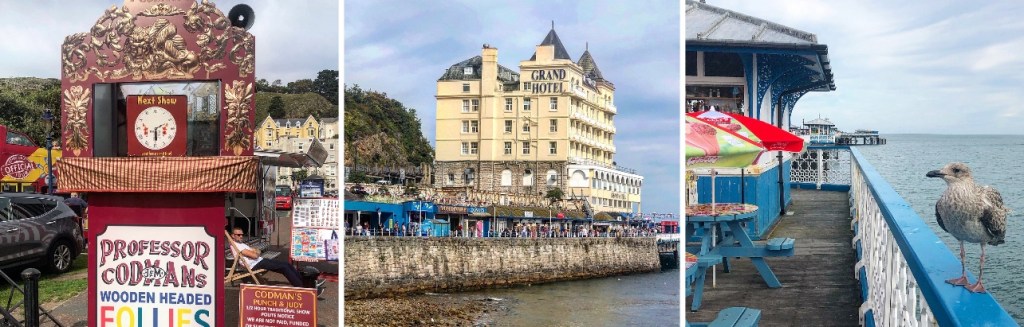
Don’t forget your bucket and spade when you visit Llandudno because the beaches are lovely and sandy in most parts, pebbly in others. If you are lucky enough to get a scorching hot day, you can sit and while away the hours and watch the jet skis dart across the bay. I’m pretty sure the longstanding, traditional donkey rides are still there, but it’s up to you if you feel that’s something you’d be interested in.
Unlike other seaside resorts in Great Britain, Llandudno isn’t just about the beach – no – here you also have dramatic mountains, ideal for walkers and explorers! No trip is complete without going up the Great Orme’s impressive limestone cliffs on the northern side of the bay, standing 207 metres above sea level. It is from here that you get spectacular views across the sea and the vast green landscape below.
You can walk up the Great Orme – and many do. You can also drive up or be ‘old school’ and take the tram. The traditional tramway is cable-hauled and has been running since 1902! In its day, it was described as ‘thrilling’ and ‘spectacular’! I wouldn’t go so far as to describe it quite so enthusiastically in this day and age, but nonetheless, it’s a little piece of history and for £8.10 per rider, return – you can’t say fairer than that for the experience!

When you do reach the summit of the Great Orme, you can grab something to eat, purchase a souvenir at the gift shop or even play crazy golf! Crazy indeed, especially on a windy day – which so often it is up there! Ladies: tie your hair up!
We decided to take the ‘healthy option’ and walk down from the Great Orme after we had spent sufficient time there. Despite the challenges of going downhill in flip-flops, it was a great opportunity to take in the panoramic views of the bay and look at the quaint little cottages and guest houses dotting the route.
If sunbathing or hiking are not your thing, you can go shopping instead. Like any modern coastal town in Britain, Llandudno has a small high street of shops, including Marks and Spencer’s and WHSmith. There’s also a theatre, a swimming baths and an Alice In Wonderland trail (apparently Llandudno was the favourite holiday destination of the ‘real Alice’ and inspiration for the Lewis Carroll book).
One place we didn’t find time to explore on this occasion was the Little Orme, which stands just over 140 metres above sea level. This is on the list for my next visit, along with a visit to the dry ski-slope and toboggans and a ride on the old-fashioned colourful cable cars! Not forgetting some seal spotting in Angel Bay! Llandudno even has gardens called Happy Valley – how could anyone possibly resist?
Picture-perfect Portmeirion
Having spent a large proportion of my childhood holidaying in North Wales, I decided to go back in time and revisit Portmeirion Village. But would it be as good as I remembered?
In short, yes.
Something of a lesser-known secret tucked away on the estuary of the River Dwyryd, Portmeirion is a flamboyant, Italianate village right in the heart of North Wales.

It was created by a Welsh architect, Sir Clough Williams-Ellis, who started work on his magnificent creation way back in 1925, when he purchased the Aber Ia Estate in Penrhyndeudraeth. He eventually completed what became Portmeirion Village in 1975, some 50 years later. Now that’s a project!
Clough was both an advocate of the rural preservation of North Wales and an eccentric architect with a passion for unique buildings. As such, he designed this colourful, quirky village and surrounded it in 70 acres of sub-tropical woodland gardens and lakes. Passion, patience and plenty of pennies required! It’s easy to see why some people describe Portmeirion as being ‘unlike any other place in Great Britain‘ – afterall, it’s not every day you drive down an A-road in Wales and stumble across somewhere quite as pleasantly peculiar as this!
So why the Italian-inspired theme? Apparently Clough wanted to create somewhere to replicate his memories of his holidays in Portofino on the Italian Mediterranean coast. Word is, he designed the gardens and buildings in Portmeirion using just his memory. If the rumours are true, Clough requested that on his death, his ashes be put in a firework or cannon and fired into the air over his Portmeirion! I guess, if you invest 50 years hard graft, you can certainly appreciate the attachment! For some, you may never want to escape….
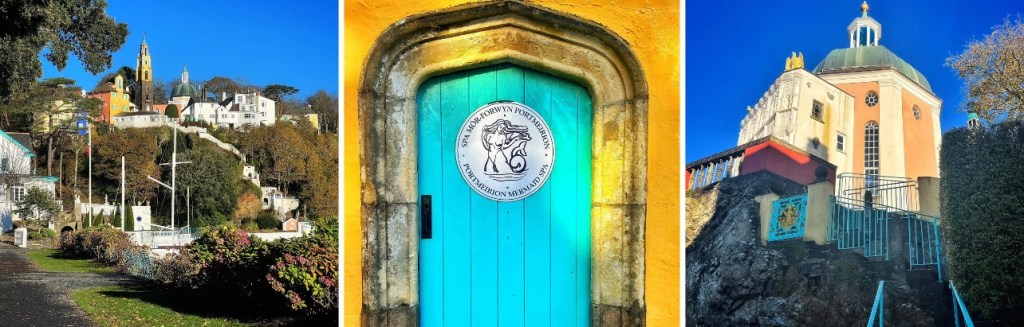
Portmeirion was also once home to the filming of a weirdly wonderful 1960’s cult tv show called ‘The Prisoner’. The concept: a retired Secret Agent (‘Number Six’) is taken to what first appears to be an idyllic village on a holiday break, but ‘The Village’ quickly transpires to be a prison where he is held captive. That village is what we now know as Portmeirion. In each of the 17 episodes, the agent tries to escape his captors in speed boats or sports cars. Indeed, Portmeirion is on the water overlooking an estuary, with its own small expanse of beach. Pretty, yes – but speed boats – a slight stretch. Oh the illusion of television!
Weird but true: Apparently the last episode was so obscure and left open to interpretation that it annoyed those diehard fans who sought answers. So much so, in fact, that the star of the show, Patrick McGoohan, had to go into hiding for a short time as he was hounded by fans demanding explanations!
The Prisoner’s cult following stretched overseas to the USA, France and all the way across to Oz – and it is fondly remembered by many as one of the most influential television series of the 60’s. As such, Portmeirion still sees flocks of fans descend from all over the globe. There were definitely some noticeable ‘Prisoner Geeks’ when we visited as well as some retro sports cars parked up.

Without question, Portmeirion is a playground for photographers and instagrammers alike. With twisting cobbled streets, winding pathways (leading to more pathways), colourful cottages of all shapes and sizes and plenty of ‘nooks and crannies’ to discover, you can explore and snap away to your hearts content. As a child, I remember Portmeirion being the best place on earth for a game of ‘hide and seek’. Back then, I wasn’t so much interested in the pretty gardens, as I was running riot in this huge, adventure haven!
Of course, what is pleasing to one eye, is not always to another and whilst I personally love places that are a bit ‘off the wall’, apparently Portmeirion doesn’t hold the same appeal for all…. If you believe all that you read, King Charles was once said to have called it “the highest slum in Britain“. I couldn’t disagree more!
A day trip to Portmeirion will set you back £12 admission fee for adults (a little less for OAPs and kids). The village is usually open all day from 09:30 – 17:30, but check times before travelling as they may differ between seasons. But why not make a night – or two – of it? If you want to push the boat out (not literally), you can choose to stay at the Portmeirion Hotel, Castell Deudreth or in one of a number of holiday cottages within the grounds.
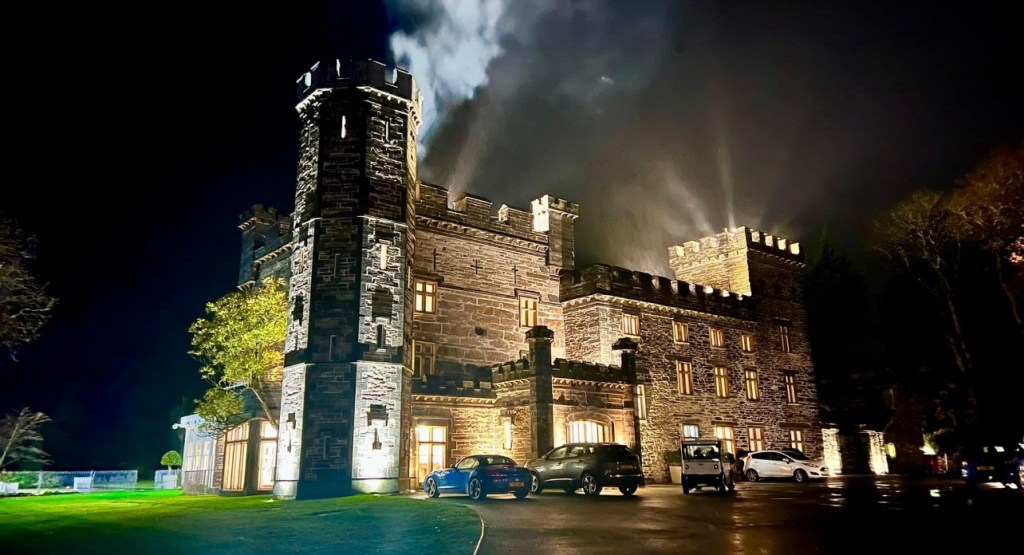
We stayed in the castle, which is exceptional – spacious rooms, delicious food and roaring fires when it’s cold outside – as well as being the perfect base to explore Portmeirion after hours. We ate in Hotel Portmeirion, which exudes fine dining and luxury – and better still, Portmeirion provide complimentary transfers to and from Castle Deudreth by a little electric car.
Every time I visit somewhere new in North Wales, I’ll be sure to update this blog. Drop your comments below 👇🏻

 Sun, See and Suitcase
All good info thanks.
LikeLiked by 1 person