
Happy Big Birthday to me! What better place to see in my fourth decade than in this fabulous city in all its Winter glory?

If you’re heading to Prague this Winter (or indeed anytime soon), take a look at my list of ten must-see sights (in no particular order) and top tips to help you get the most out of your visit!
It goes without saying that Prague is a photographers dream (and most definitely the perfect place to try out the camera on my new iPhone) – so if you’re snap-happy like me, Prague during Christmas may well be your dream destination.
Read on to find out why….
1. Old Town Square and the Astronomical Clock
Old Town is not only the oldest, but also the most central part of the city – so a great place to start (or end) your day. Dating back to the 9th century, this was once the place where trade merchants from around the world would meet. Today it is a bustling area comprising historical buildings, shops, restaurants and drinking holes (both traditional and contemporary). Inevitably, this also means that Old Town Square draws in the biggest crowds and has the highest commercialism – one to remember if you’re eating and drinking on a budget.
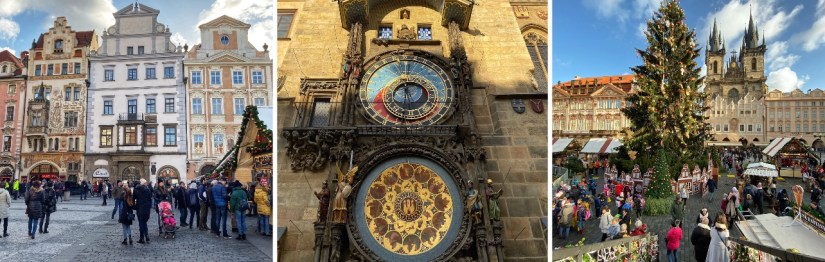
If your visit falls during the Christmas festivities, you’re in for a treat as the Czechs go all out on the winter wonderland theme; a huge Christmas Tree dominates the square and a traditional Christmas market brimming with wooden huts serves up hot wine, hearty food and haberdashery.
Whether you visit Old Town Square in the day or night (or both), you can’t fail to miss the gothic delight that is the Church of Our Lady before Tyn. This impressive church is sometimes used as a music hall and especially for carol concerts in the Winter. Although I had no real interest in going into the church, I certainly appreciated its pointed exterior at it’s magnificent best, lit up at night.
Also found on Old Town Square is the Town Hall and its famous medieval Astronomical Clock. Not only does it tell the time, but it also shows the movement of the planets orbiting the Earth, symbolised by the signs of the zodiac. If you decide to join the crowds for the hourly ‘Apostle Parade’ (as we did, to my boyfriends bemusement), you will be treated to a short display of rotating apostle figures appearing from the windows and a skeleton ringing a bell. I’m not sure what I was expecting but it was a slight anticlimax. But, hey – go and see it for yourself and make up your own mind.
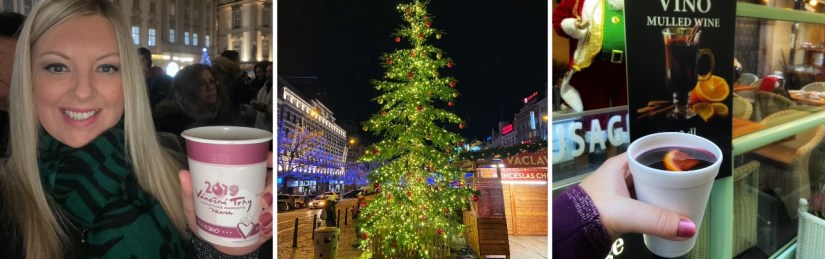
In my opinion, Old Town Square and its festive atmosphere is best appreciated wrapped up in a scarf, mulled wine in hand. There really is nothing better to warm your cockles as the temperatures drop (and they really do in Prague!).
2. Prague Castle: a mini-village
The Prague Castle estate is the largest ancient castle complex in the world. Impressive! With an expansive network of courtyards, towers, churches, museums, shops and cafes spanning almost 600 x 150 metres that surely makes it a mini-village in itself! Upon entry, expect to have your bags searched for liquids and weapons. Don’t expect, however, to get a smile out of the Castle guards – these guys are straight-faced professionals (think the Buckingham Palace guards, complete with their own ‘changing of the guards’ at noon each day).

Arguably the most impressive building at the Castle is that of the Roman Catholic Saint Vitus Cathedral, constructed by King Wenceslas in 930. Today it is the seat of the Archbishop of Prague and you can visit the Cathedral, it’s tower and tombs if you have the time and inclination. Entry is free to enter the main part of the cathedral, but charges do apply for the tower, crypt and choir service.
You can easily while away an hour once inside the Castle grounds. St George’s Basilica (the red and green spired church above) is Pragues best preserved place of worship and interesting. Quaint little shops and eateries line the cobbled alleyways, whilst street performers play musical instruments in traditional dress. Again, time your visit with Christmas and you’ll also be happy to find a few wooden huts selling hot cider and Czech crafts.
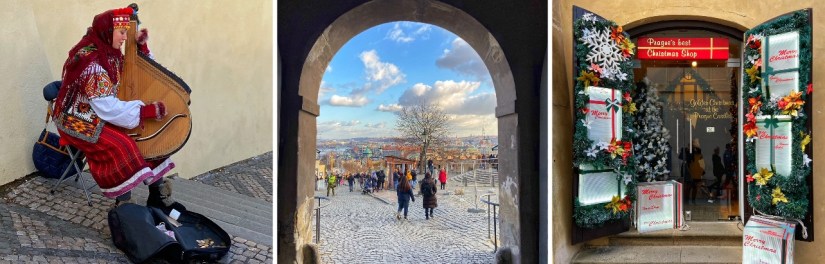
With all of that – and fantastic views to boot – it’s little wonder that Prague Castle is the most visited tourist attraction in the city.
3. Charles Bridge
Prague’s most famous bridge dates back to the 14th century and crosses the Vltava River.

It was originally called Stone Bridge but took its new name in 1870 after Charles IV – and was mainly used for jousting tournaments. It is from here that you can expect to get fantastic panoramic views from one side of the city to the other.
The Bridge gets pretty busy; we went over it twice during our trip, at different parts of the day and on each occasion it was full of tourists, buskers and artists. Visitors to the Charles Bridge will see it lined with 30 statues that depict Catholicism and religious figures – favoured as perching points (and toilets) by seagulls!
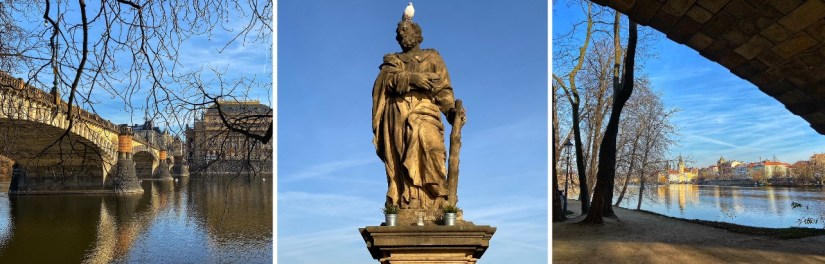
The Powder Tower at the foot of the Bridge is one of the original 13 gates into Prague, designed to be an attractive welcome as opposed to a defence tower. Despite this, the Tower was used to store gunpowder in the 17th century – and the name stuck.
4. Wenceslas Square
“Good King Wenceslas last looked out”….how very apt for this time of year. Wenceslas Square, complete with GKW’s statue in front of the National Museum, is the city’s top spot for business, shopping and nightlife.
Like Old Town Square, expect to pay top dollar in this area (yet when I say that, don’t forget that even the more expensive parts of Prague really aren’t what can be considered pricey when compared to many European cities).
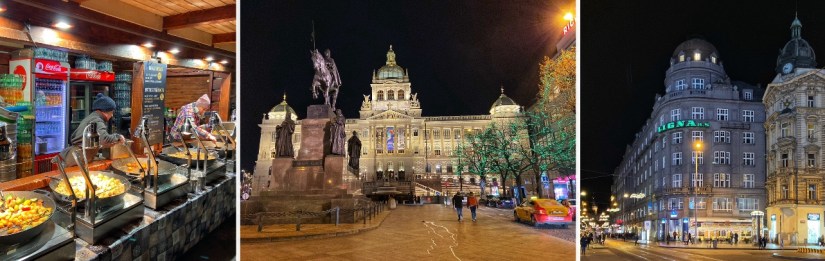
If you go to Prague with a mission to shop until you drop, this is probably the area you want to find yourself as it’s here that you’ll find high street to high end and anything in between. Hotels big and small mix with restaurants fancy and fast-food along this popular Square (although it feels more like a long road). If mulled wine and markets are your favourite Christmas treat, of course you’ll find them here too.
Wenceslas Square, due to its size, is also frequently used to facilitate large parades and protest marches. During our trip, thousands gathered on the Square, calling for the Czech Prime Minister Andrej Babis to resign. Prague politics in action! Makes a change from Brexit.
5. The Lennon Wall
Like me, you might wonder what the association is between Prague and John Lennon? I just assumed it must have been one of the first places that The Beatles toured…
Not so. In actual fact, in the 1960s the wall outside the French Embassy started as a public art site used to display messages of peace, love and freedom, typical of that era.
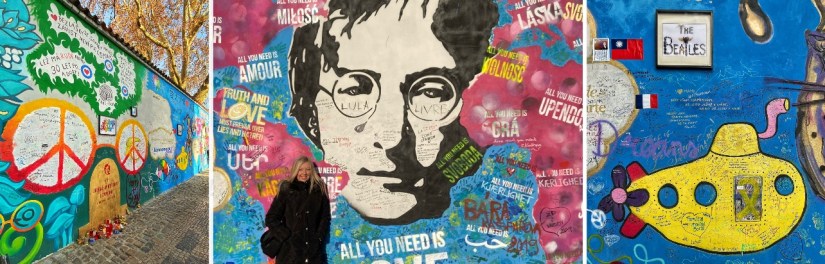
Following John Lennon’s assassination in 1980, the wall took on more of a ‘Lennon Theme’. Much to the irritation of Communist leadership, the popularity of the wall grew, both in scale and in the messages of protest. Over the years, what is now known as Lennon Wall has been scrubbed clean a few times, yet continues to be repainted and added to. In fact, visitors are welcome to add their own scribble, should they wish to do so.
Of course, like any town or city, if something is popular, generally speaking you’ll find a pub that dedicates itself to the cause, despite no real affiliation.
6. Woodland walk up to the Hanavsky Pavilion
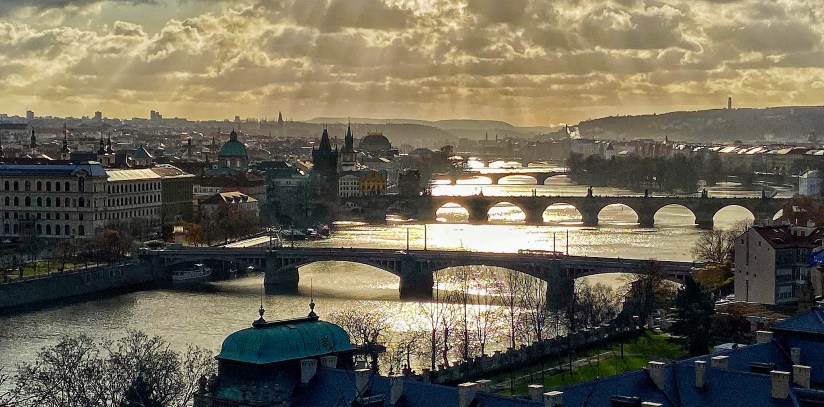
A way to escape the bustling crowds is to head up into the hills (nothing too strenuous!). If you leave the Charles Bridge and look upwards to your left, you will spot a fairly steep path leading upwards. This takes you into a little woodland, covered in leaves, toadstools and snowdrops. Turns out that the views down into Prague are pretty spectacular from this spot too, with the morning sun hitting the bridges perfectly for a photo.
If you continue through the woodland, a short time later you will stumble across a pretty building that looks like it belongs in a fairytale – the art nouveau Hanavsky Pavilion.
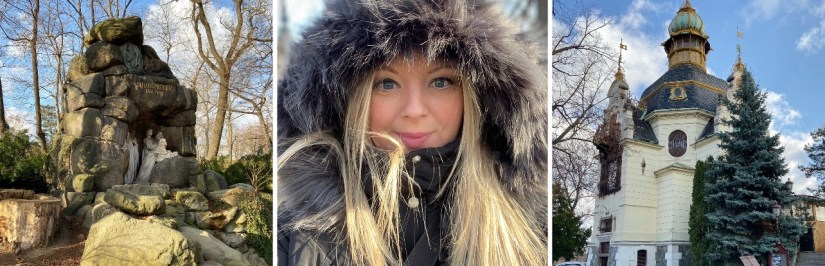
The Pavilion was built in 1891 for the Czech Jubilee Exposition and is now a fancy restaurant, boasting some of the best views of the River Vltava and the city below.
7. Zizkov and the ‘Television Tower’
The neighbourhood of Zizkov, although still firmly in the centre of Prague, sits slightly on the outskirts and has a more working-class, communist, less polished feel to it than the main centre.
I should say at this point that public transport (trams, trains and buses) are frequent, cheap and easy to use – or so I’m told. In a mission to get our step count up and burn off our beer calories, we decided to sightsee entirely on foot, since Prague is a compact city and easy enough to do. If your feet let you, you’ll most definitely experience the sights, sounds and smells of the city far better off your own steam.
In Zizkov, the streets are quiet, the parks are small and the pubs are plentiful. This is also where you will find the ‘unique’ structure that is Television Tower.
This unusual art piece/ eye sore has been described as “the second ugliest building in the world” (the first being the Morris Mechanical Building in Baltimore, USA). The first thing that will probably strike you is the giant Miminka (babies) that can be seen crawling up the Tower.

The Czech artist responsible for the design – David Cerny – certainly had an interesting vision. Beauty is in the eye of the beholder when it comes to this building.
Standing 216 metres into the sky, visitors can go up to the observation deck for around the equivalent of £8 each – or to the restaurant on the upper deck where you can get a nice meal or a cocktail with views.
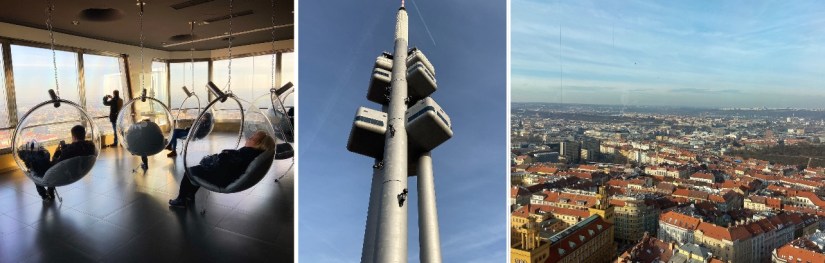
Unfortunately due to a private event, the restaurant was shut when we visited (one downside to a December visit – Christmas parties that you’re not invited to, made worse when it’s your Birthday too!).
But, not to worry, the observation deck was good enough with three rooms delivering views for miles and comfy bubble chairs to rest your weary legs! If I could make an ‘observation’ of my own however, it would be that TV Tower might like to clean the perspex glass more often; I’ve definitely been to better observation decks in other cities.
8. Stunning Architecture and Cozy Cobbled Streets
Without question, one of the best sights that you will see in Prague can be found across the entire city – the impressive architecture at every turn. Prague is the city of a thousand spires, red rooftops, intricate detail and cobbled side streets.
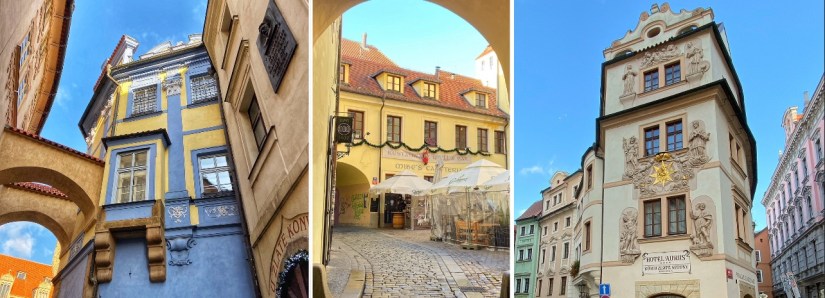
I’d defy anyone not to be impressed. I’d also confidently challenge you to find any two buildings the same. The loveliest thing about the streets of Prague is the colour, the mismatched shapes and the old-fashioned charm of times gone by. I can only imagine how gorgeous it must look when it snows.
The architecture is a rich mixture of styles from over the centuries; Romanesque, Renaissance, Baroque, Gothic and modern.
The Josefov (Jewish Quarter) has some stunning architecture too. Until 1850, the area was simply called ‘Jewish Town’, but it took its new name from the Holy Roman Emperor who gave the Jews their equal rights. Josefov is nestled between Old Town Square and Charles Bridge and is a must see for all historians keen to learn more about its story. The Jewish Museum Ceremonial Hall is one of the most visited places by visitors. It was first established in 1906 as a place to store and preserve valuable artefacts. During WWII, the Jewish population in Prague were sent to concentration camps during the Holocaust and the Nazis took over the management of the Prague Jewish Museum. This meant that the area became deserted and used only as a storage space for their belongings.
Today, it has a working synagogue and visitors can pay to go inside (comprising six synagogues) and see the oldest European Jewish cemetery.
If you have time on your side, in addition to the buildings I’ve already mentioned, try and make sure you see the National Theatre, St Nicholas Church, the Rudolfinium, the Belvedere and St Agnes Covent – for some of the best designs Prague has to offer.
9. Forget the red lights – it’s all about Art In The City!
If you love street art like I do, you’ll love spotting some interesting sculptures and art pieces as you make your way around the city.
If you go to the Franz Kafta Museum you will spot some of Czech artist David Cerny’s controversial artworks such as the urinating men! The most observant will notice that the men actually spell out quotes with their urine! Furthermore, you can even have your own message spelt out for a small fee – perfect for that special occasion, I’m sure!
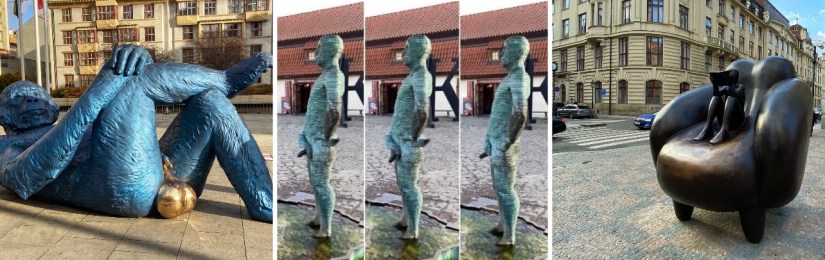
And just look at ‘King Kong’s Balls’ there! As you’d expect, this big blue monkey caught the attention of lots of people, all queuing to have their photo taken with it! A definite talking piece.
10. You can’t go to Prague without sampling the bargain booze and food!
Let’s face it, many people who choose Prague as a holiday destination do so for the cheap beer. It’s no wonder it’s popular with big groups and stag/ hen parties. You can expect to get a pint of local beer for around 90p in most places. Cocktails range from around £4.50 (2019 prices).
We must have tried at least 15 pubs/ bars/ lounges during our stay – from the ‘working mans’ local to trendy hookah bars. The best we found was a hidden gem called ‘Anonymous Shrinks Office‘, where you enter through a secret door and pick your cocktail based purely on what picture you ‘most relate to‘ (based on the Rorschach Test).
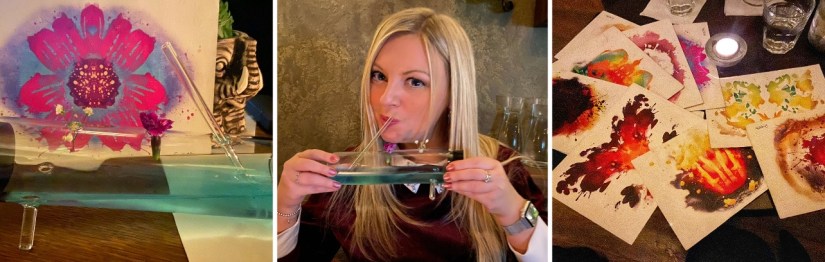
What turns up is a complete surprise, which is great fun! If you’re off to Prague, the Anonymous Shrinks Office has to go on your itinerary!
When I travel, I generally like to eat as the locals do – paella in Spain, kleftiko in Greece, pizza in Italy….but having read that the Czech food isn’t all that wonderful (lamb knuckle, dumplings etc) we – perhaps shamefully – ate Italian Gnocchi, Mexican Fajitas and American Burgers. I can still taste the feta and red onion burger I had in Black Betties Grill now!
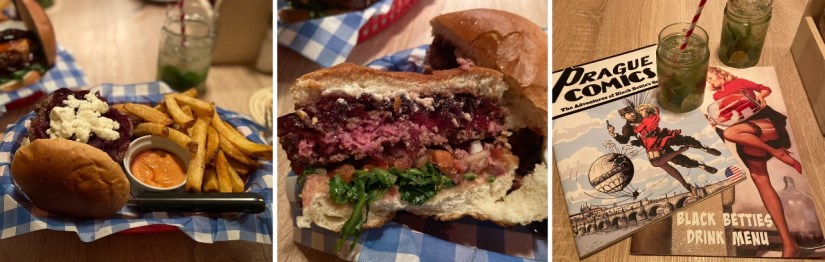
There were plenty of places to grab a good breakfast all over the city. Again, very cheap at around £4.50 for pancakes, latte and orange juice.
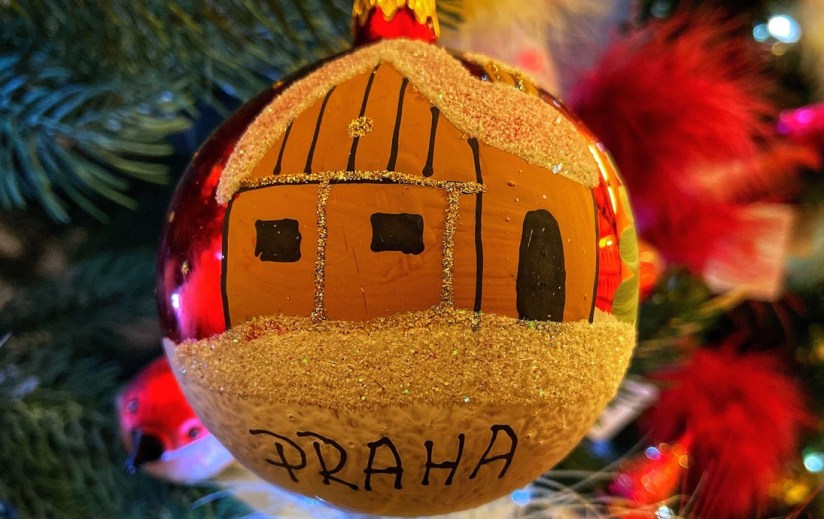
So there it is – Praha – bet you want to go now? If you do, let me know your thoughts in the comments below 👇🏻

 Sun, See and Suitcase
1 thought on “Prague 🇨🇿”